
Introduction
Learning a new language becomes much easier when you start with the words people actually use every day. That is exactly why basic French words matter for beginners who want real conversational confidence, not just textbook memorization. French is spoken in over 30 countries and is used daily in travel, education, business, and culture, making it one of the most practical languages to learn globally.
Many learners struggle because they start with complex grammar instead of focusing on useful vocabulary that appears in real conversations. Mastering basic French words allows you to reduce fear, increase comprehension, and begin forming simple sentences naturally. Vocabulary is the foundation of communication, and without it, grammar alone cannot make you fluent.
Why You Need to Learn these Basic French Words
This article focuses on basic French words you will hear, say, and recognize immediately when speaking with native French speakers. These words cover greetings, everyday questions, simple responses, directions, food, emotions, and polite expressions. By learning them first, beginners—both kids and adults—can quickly start participating in real conversations.
Whether you are learning French for school, travel, career growth, or personal enjoyment, starting with practical vocabulary saves time and builds confidence. This list is designed to be memorable, relevant, and easy to practice, giving you a strong foundation for all future French learning.

The 100 Basic French Words You’ll Actually Use
1. Essential Greetings and Polite Expressions (Words 1–15)
Mastering greetings and polite phrases is the first step in real conversations. These basic French words are used every day and if you are a beginner, it will give you immediate confidence in making real-time conversations.
- Bonjour – Hello / Good morning
Use it when meeting someone or starting a conversation in the morning. - Bonsoir – Good evening
Perfect for greeting someone after late afternoon or at night. - Salut – Hi / Bye
Informal greeting used among friends and peers. - Au revoir – Goodbye
A polite way to leave a conversation. - Merci – Thank you
Shows gratitude in any situation, from small favors to larger gestures. - Merci beaucoup – Thank you very much
Use for added emphasis when you are especially grateful. - S’il vous plaît – Please
Essential for polite requests in shops, schools, or restaurants. - Excusez-moi – Excuse me
Used to get someone’s attention or apologize politely. - De rien – You’re welcome
A standard response after someone says “merci.” - Oui – Yes
Simple but vital for agreeing or responding affirmatively. - Non – No
Equally important to express disagreement or refusal. - Peut-être – Maybe
Useful in uncertain situations or casual conversations. - Comment ça va ? – How are you?
Great for starting a friendly conversation. - Ça va bien – I’m fine
A typical response to “Comment ça va ?” - Enchanté(e) – Nice to meet you
Use when being introduced to someone new.
These 15 words form the foundation of polite daily interactions, making them the first set of basic French words every beginner should memorize and practice aloud.
Read Also: The Best Way to Learn French: A Complete Beginner-Friendly Guide
2. Common Responses and Conversation Fillers (Words 16–30)
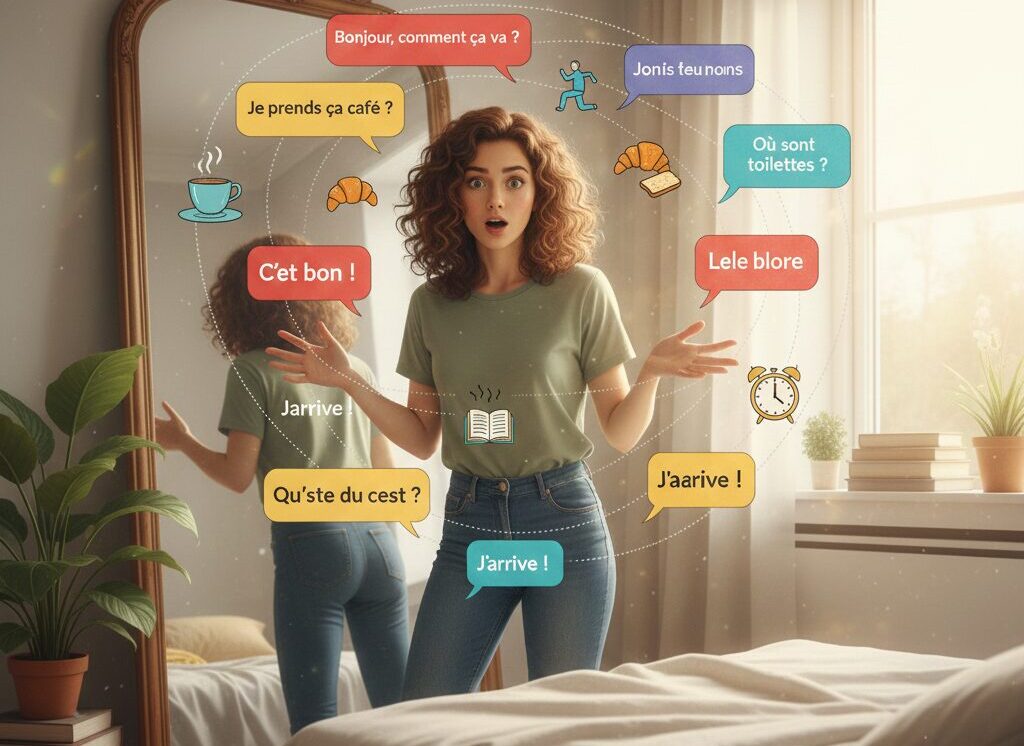
These are basic French words to help your conversations flow naturally. They allow learners to respond, react, and stay engaged even with limited vocabulary.
- D’accord – Okay / Alright
Used to show agreement or understanding in everyday conversations. - Bien sûr – Of course
Expresses certainty or willingness, often in friendly replies. - Pourquoi – Why
Essential for asking questions and showing curiosity. - Parce que – Because
Used to explain reasons, making conversations more meaningful. - Quoi – What
Helpful when you need clarification or didn’t hear clearly. - Qui – Who
Used to ask about people involved in a situation. - Où – Where
Important for directions, locations, and meeting plans. - Quand – When
Used to ask about time or scheduling. - Comment – How
Allows learners to ask for explanations or methods. - Désolé(e) – Sorry
Used to apologize or show sympathy. - Pas de problème – No problem
A friendly way to reassure someone. - Je pense – I think
Helps children and beginners express opinions. - Je crois – I believe
Useful for sharing thoughts politely. - Peut-être que – Maybe that
Softens statements and shows uncertainty. - Exactement – Exactly
Confirms agreement and understanding.
These basic French words allow learners to participate actively in conversations, even before mastering full sentences. They reduce fear, build confidence, and encourage continuous speaking.
3. Numbers, Time, and Everyday Essentials (Words 31–45)
This group of basic French words will help you talk about time, quantity, and routine activities. These words appear constantly in real conversations, especially when planning, shopping, or describing daily life.
- Un – One
Used for counting, ordering items, and simple descriptions. - Deux – Two
Commonly used when making choices or comparisons. - Beaucoup – A lot
Helps express quantity and emphasis in conversations. - Peu – A little
Useful when talking about small amounts or limits. - Aujourd’hui – Today
Frequently used when discussing plans or events. - Demain – Tomorrow
Essential for future planning and scheduling. - Hier – Yesterday
Allows learners to talk about past experiences. - Maintenant – Now
Useful for urgency, timing, and instructions. - Toujours – Always
Common in habits, routines, and personal statements. - Parfois – Sometimes
Helps describe frequency in everyday speech. - Jamais – Never
Used to express strong preferences or habits. - Tard – Late
Common when discussing time and appointments. - Tôt – Early
Useful for routines and schedules. - Ici – Here
Essential for location-based conversations. - Là-bas – There
Used when pointing out places or directions.
Learning these basic French words allows you as a beginner to talk about real-life situations without hesitation. Using them does not make you fluent automatically, but they will help you feel capable of expressing time, place, and quantity clearly and confidently, as you learn more.
Read Also: Why Learning French Is a Career and Life Advantage in a Global World
4. Food, Places, and Everyday Nouns (Words 46–60)
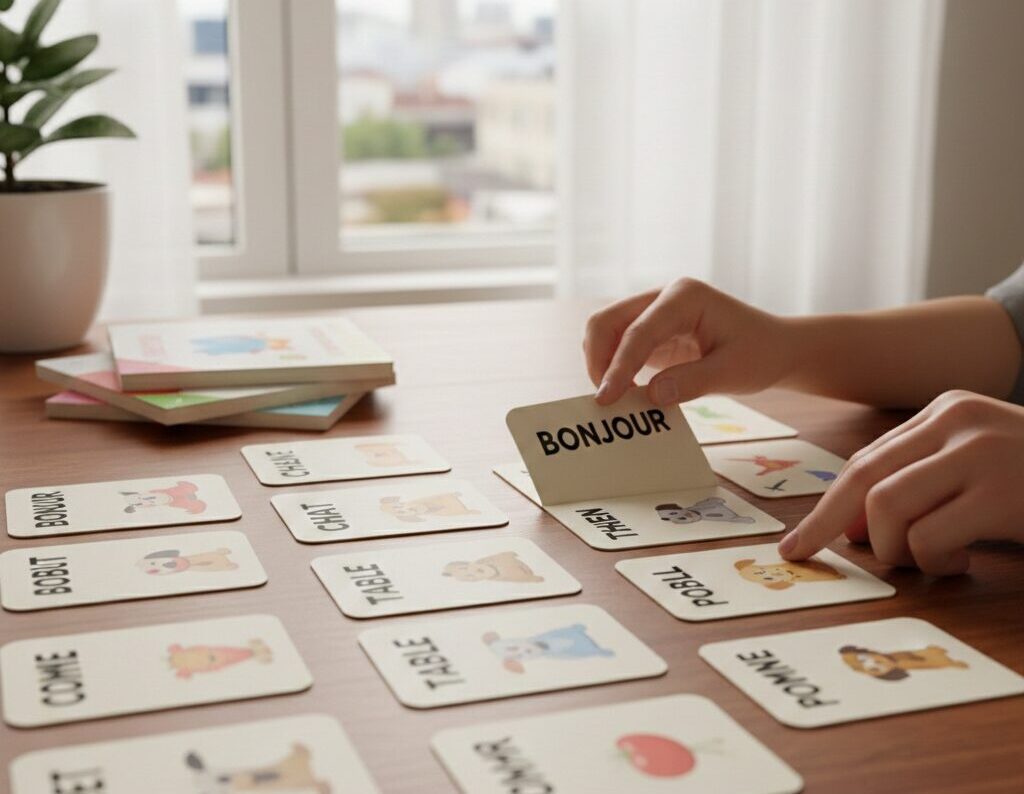
Food and location-related basic French words come up naturally in conversations about daily life. Whether ordering a meal, talking about where you are, or describing simple needs, these words make interactions feel practical and real.
- Eau – Water
One of the most useful words when eating out or traveling. - Nourriture – Food
Used in general conversations about meals and preferences. - Pain – Bread
A common item in French culture and daily meals. - Maison – House
Helps learners talk about home and family life. - École – School
Essential for children and parents discussing education. - Travail – Work
Frequently used in adult conversations and routines. - Magasin – Shop
Useful for shopping, errands, and directions. - Restaurant – Restaurant
Common when planning outings or ordering food. - Rue – Street
Important for giving and understanding directions. - Ville – City
Used when talking about where someone lives or travels. - Pays – Country
Helps express nationality and origin. - Nom – Name
Essential when introducing yourself or others. - Temps – Time / Weather
A versatile word often heard in everyday speech. - Chose – Thing
Helpful when you cannot recall a specific word. - Personne – Person / Nobody (context-based)
A common word that appears in many conversations.
These are basic French words to make everyday conversations smoother and more natural. They help beginners handle real-life interactions like shopping, eating, and describing their surroundings without feeling stuck.
5. Common Verbs You Will Use Every Day (Words 61–75)
Verbs give life to sentences, and these basic French words help beginners express actions clearly. They appear constantly in real conversations, making them essential for anyone learning how French is actually spoken.
- Être – To be
Used to describe identity, feelings, and situations. - Avoir – To have
Essential for expressing possession and age. - Aller – To go
Common in conversations about movement and plans. - Faire – To do / To make
A flexible verb used in many everyday expressions. - Dire – To say / To tell
Helps learners communicate thoughts and messages. - Parler – To speak
Important when talking about language and communication. - Voir – To see
Used in daily conversations and storytelling. - Venir – To come
Appears often when discussing visits or arrivals. - Prendre – To take
Common in food, travel, and routine activities. - Donner – To give
Useful for sharing and polite interactions. - Aimer – To like / To love
Expresses preferences and emotions clearly. - Vouloir – To want
Essential for stating needs and desires. - Pouvoir – To be able to / Can
Helps ask permission or express capability. - Savoir – To know
Used when talking about knowledge or skills. - Mettre – To put / To place
Appears often in instructions and daily actions.
These action-based basic French words allow learners to build complete sentences instead of relying on single words. Mastering these verbs makes conversations feel natural and confident rather than fragmented.

6. Describing the World Around You – Adjectives and Descriptors (Words 76–90)
Once learners know nouns and verbs, adjectives make conversations more expressive and natural. These basic French words help describe people, places, feelings, and everyday situations in a way that sounds real, not robotic. They appear often in casual chats, school settings, and family conversations.
- Bon / Bonne – Good
Used to describe quality, behavior, or experiences. - Mauvais / Mauvaise – Bad
Helpful when giving opinions or expressing dissatisfaction. - Grand / Grande – Big / Tall
Commonly used to describe people, objects, and places. - Petit / Petite – Small / Short
Pairs naturally with grand in daily descriptions. - Beau / Belle – Beautiful
Frequently used for people, places, and things. - Vieux / Vieille – Old
Used when talking about age or objects. - Jeune – Young
Common in conversations about age and family. - Nouveau / Nouvelle – New
Appears often in school and daily life. - Content / Contente – Happy
Helps learners express emotions clearly. - Fatigué / Fatiguée – Tired
A very relatable word in daily conversations. - Facile – Easy
Useful in school and learning contexts. - Difficile – Difficult
Often used to describe tasks or experiences. - Rapide – Fast
Common when talking about time or movement. - Lent / Lente – Slow
Pairs naturally with rapide. - Important – Important
Frequently used in school and family discussions.
These descriptive basic French words help learners move beyond basic statements into richer, more natural speech. With just a few adjectives, conversations become clearer, more personal, and more engaging.
Read Also: 7 Proven Benefits of Learning A New Language for Kids
7. Polite Expressions and Conversation Fillers – Sounding Natural and Respectful (Words 91–100)
Politeness is a big part of French culture, and these basic French words help learners sound respectful, friendly, and confident in real conversations. These expressions are used daily in homes, schools, shops, and social settings, which makes them essential for anyone learning French for practical communication.
- Merci – Thank you
One of the most frequently used basic French words in daily life. - Merci beaucoup – Thank you very much
Adds warmth and appreciation to simple gratitude. - S’il vous plaît – Please (formal)
Used with adults, teachers, or strangers. - S’il te plaît – Please (informal)
Common among friends, siblings, and classmates. - De rien – You’re welcome
A polite response after receiving thanks. - Pardon – Sorry / Excuse me
Used when interrupting or making a small mistake. - Excusez-moi – Excuse me
Helpful in public places or when asking for attention. - D’accord – Okay / Agreed
Very common in casual conversations. - Bien sûr – Of course
Shows willingness and positivity in responses. - À bientôt – See you soon
A friendly way to end conversations.
Mastering these polite basic French words helps learners sound natural and culturally aware, even at beginner level. With these expressions, conversations feel smoother, kinder, and more confident, which is exactly what real communication in French is about.
Conclusion
Learning basic French words is the fastest and most natural way to begin speaking French with confidence. When learners focus on words they actually hear and use daily, progress feels exciting instead of overwhelming. These basic French words create a strong foundation for pronunciation, listening, and sentence building, especially for kids and beginners who need early wins to stay motivated.
If you want your child to move beyond memorization and start using French naturally, structured guidance makes a clear difference.
Learn French with us at Educify!
Enroll with us to learn French through patient, engaging lessons designed for real communication, led by experienced tutors across the US and Canada. Click here to know more.