
Learning a musical instrument is no longer just a hobby. In 2025, it has become a valuable personal skill that supports creativity, confidence, and even cognitive development. Among all instruments, the guitar remains one of the most popular choices for beginners. If you are searching for how to play guitar, chances are you want clear guidance, not confusing theory or unrealistic shortcuts.
Many beginners quit early because they are overwhelmed with scattered advice online. Videos contradict each other, exercises feel disconnected, and progress seems slow. Learning how to play guitar properly requires structure, patience, and the right learning support. This guide breaks everything down clearly for beginners, focusing on what actually matters, what you should learn first, and why having a standard tutor makes a real difference.
Why Learning How to Play Guitar Still Matters in 2025
Even as technology reshapes how people learn, create, and consume music, the guitar continues to hold a strong place in modern education and personal development. Learning how to play guitar remains relevant in 2025 because it combines creativity with structure in a way few skills do. It is not just about producing sound. It is about training the mind and body to work together with intention.
When beginners start learning how to play guitar, they immediately engage multiple skills at once. Hand coordination improves as both hands perform different tasks. The brain processes rhythm, timing, and pitch simultaneously. Over time, this strengthens memory and listening ability. Many learners notice that they become better at recognizing patterns, remembering sequences, and focusing for longer periods. These benefits extend into academic work and daily tasks.
Emotional expression is another reason learning how to play guitar still matters. Music provides an outlet that words often cannot. Beginners use the guitar to release stress, process emotions, and express creativity. In a fast paced world where digital distractions are constant, learning how to play guitar offers a grounded and meaningful way to slow down and engage deeply with something tangible.
While guitar learning is more accessible than ever through apps and online videos, accessibility alone does not guarantee progress. In 2025, many beginners confuse endless content with effective learning. Jumping between tutorials without structure often leads to frustration. Learning how to play guitar well still requires guidance, feedback, and a clear progression path that builds skills step by step. Without this structure, beginners develop bad habits that slow improvement.
The guitar also remains one of the most versatile instruments available. Whether someone is drawn to worship music, pop, blues, folk, or songwriting, learning how to play guitar provides a strong foundation that adapts across styles. Chords, rhythm, and technique transfer easily, allowing beginners to explore different genres as their confidence grows. This flexibility keeps learners engaged long term and makes the guitar a skill worth investing in even in 2025.
What Should a Beginner Guitarist Learn First?
This is one of the most searched questions online, and it matters more than people think. Many beginners fail because they start with the wrong priorities.
When learning how to play guitar, the first things you should learn are not songs or advanced chords. You should start with fundamentals that support everything else.
1. Understanding the Guitar Itself
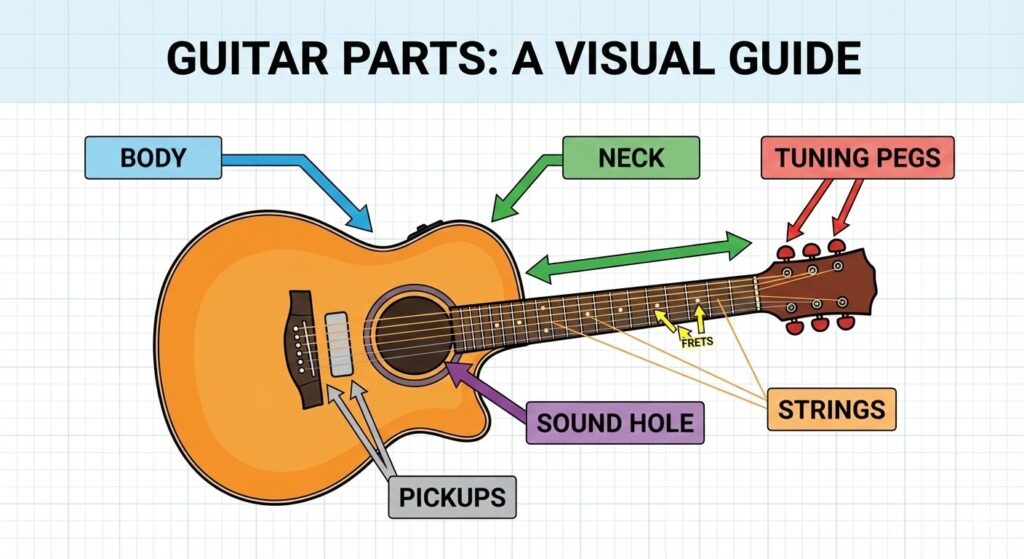
Before playing, beginners need to understand basic guitar parts. This includes the body, neck, frets, strings, tuning pegs, and sound hole or pickups. Knowing these parts helps you follow instructions correctly and avoid confusion during lessons.
2. Proper Posture and Hand Position
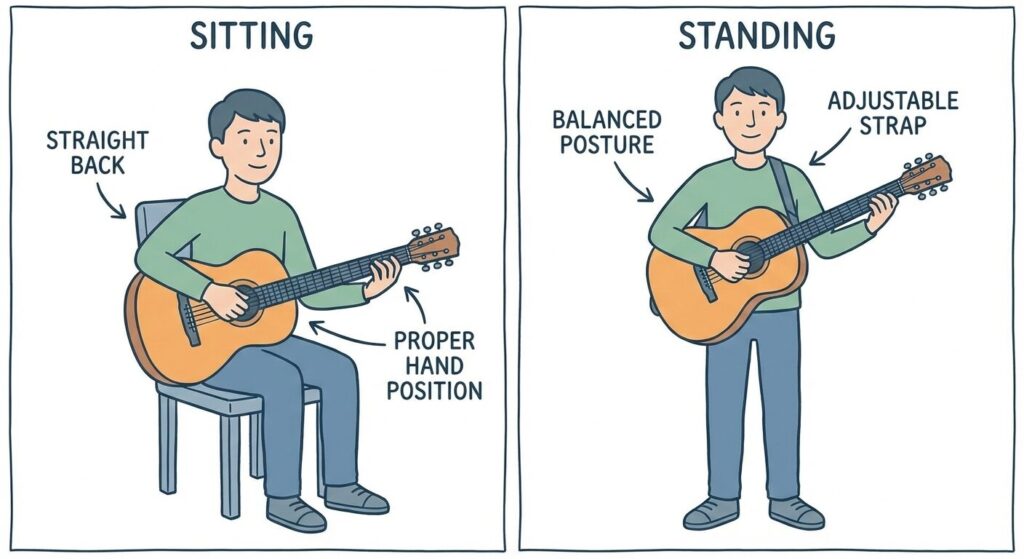
Learning how to play guitar starts with how you sit, stand, and hold the instrument. Poor posture leads to discomfort and limits progress. A good tutor corrects this early, preventing bad habits that are hard to fix later.
3. Tuning the Guitar
Playing an untuned guitar trains your ear incorrectly. Beginners should learn how to tune using a tuner app or clip on tuner before every practice session. This step alone improves sound quality instantly.
4. Basic Finger Strength and Coordination
Before chords, beginners need finger exercises. These help build strength and flexibility. Learning how to play guitar becomes much easier when your fingers respond naturally to the strings.
Choosing the Right Guitar as a Beginner
One of the most common mistakes beginners make when learning how to play guitar is starting with the wrong instrument. Many people focus on brand names, appearance, or what their favorite artist uses, instead of comfort and practicality. For beginners, comfort matters far more than brand reputation. A guitar that feels awkward or painful to play often leads to frustration and early quitting.
When learning how to play guitar, the instrument should fit your body and hands. The size of the guitar, the width of the neck, and the tension of the strings all affect how easy it is to practice. Beginners need an instrument that encourages daily practice, not one that makes playing feel like a struggle.
Acoustic guitars are a popular starting choice because they are simple and require no additional equipment. You can pick one up and start practicing immediately. However, acoustic guitars usually have steel strings, which can feel hard on the fingers at first. This discomfort is normal, but for some beginners it slows progress.
Classical guitars are another strong option. They use nylon strings, which are softer and gentler on beginner fingers. The wider neck can help some learners place their fingers more accurately when forming chords. This makes classical guitars especially helpful for younger learners or adults with sensitive fingers.
Electric guitars are often misunderstood. Many beginners assume they are harder to learn, but electric guitars actually require less finger pressure. This can make chord playing easier in the early stages. However, electric guitars require an amplifier and cables, which adds extra setup and cost.
A standard tutor plays an important role in helping beginners choose the right guitar. Tutors consider hand size, finger strength, learning goals, and musical interests. When the guitar fits the learner properly, motivation stays high and practice becomes more consistent. This early decision has a lasting impact on how smoothly the learning process unfolds.
What Are the 4 Basic Guitar Chords Every Beginner Should Know?
When beginners search how to play guitar, they often rush into chord learning. Chords are important, but only when introduced correctly.
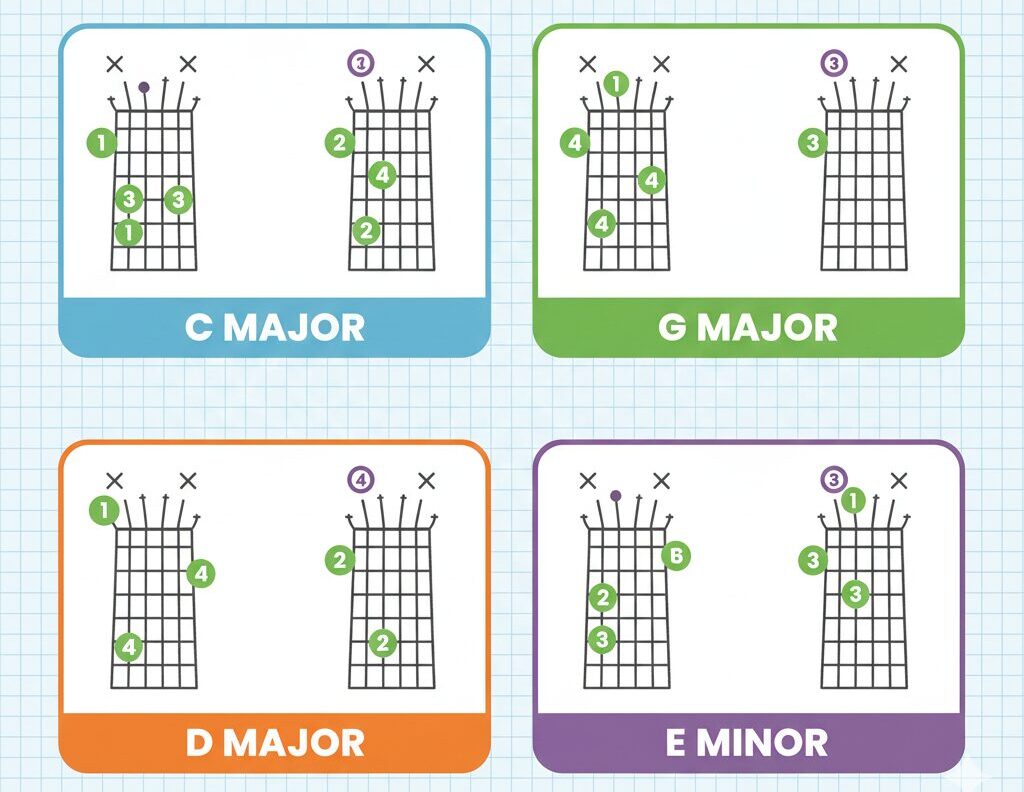
The four basic guitar chords most beginners start with are:
- C Major
This chord introduces finger stretching and teaches finger placement accuracy. It helps beginners understand how chord shapes work. - G Major
G Major develops finger independence. It is widely used in many songs, making it practical and motivating. - D Major
This chord helps beginners practice compact finger positioning and clean string strumming. - E Minor
E Minor is often the first confidence boosting chord. It sounds full and is easy to play, making beginners feel progress quickly.
Learning how to play guitar becomes smoother when these chords are practiced slowly with proper transitions. A tutor ensures you do not rush through them with poor technique.
Strumming Patterns Beginners Should Learn Early
Strumming is one of the most overlooked parts of learning how to play guitar, yet it is what brings music to life. Many beginners focus heavily on finger placement and chord shapes, but without rhythm, even correct chords sound flat. Strumming is what turns individual notes into music that feels natural and expressive.
When beginners start learning how to play guitar, simple downstrokes should come first. Downstrokes help learners focus on keeping a steady tempo without overwhelming the hands. At this stage, the goal is not speed but control. Playing slow, consistent downstrokes while counting beats builds a strong rhythmic foundation.
Once downstrokes feel comfortable, beginners can introduce basic down up patterns. These patterns teach coordination between the strumming hand and the counting of beats. Learning when to strike the strings and when to pause is just as important as playing the chords themselves. This stage helps beginners avoid rushing or dragging the rhythm.
Understanding timing is critical when learning how to play guitar. Beginners should practice counting aloud or using a metronome to internalize rhythm. Feeling the beat helps songs sound smooth rather than mechanical. This skill also makes it easier to play with other musicians later on.
Strumming patterns also help beginners recognize musical structure. Many songs use similar rhythms, so mastering a few basic patterns allows learners to play a wide range of songs. With proper guidance, beginners learn how to switch strumming patterns naturally to match different song styles.
What Is the 80 20 Rule in Guitar Learning?
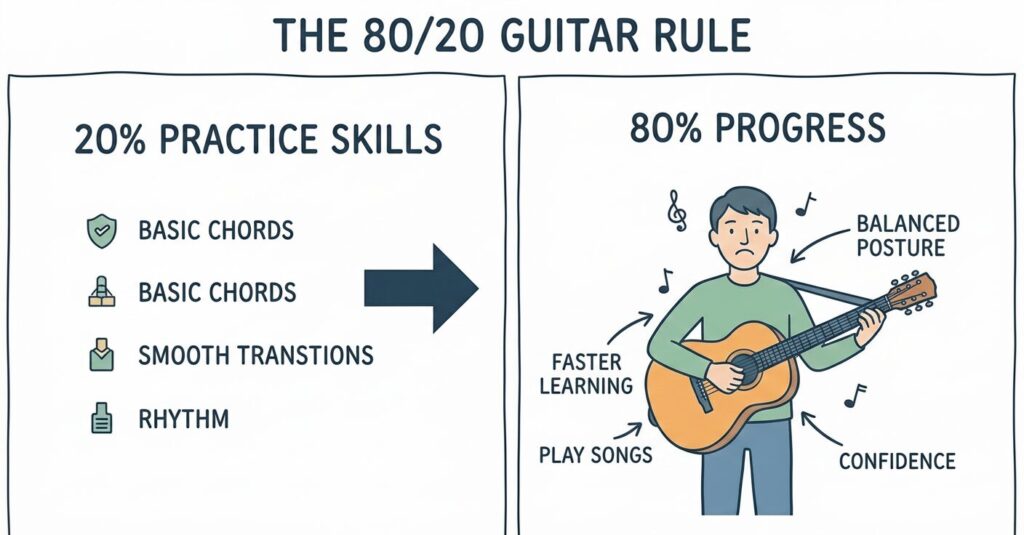
The 80 20 Pareto rule applies strongly to music. It means that 20 percent of focused practice produces 80 percent of progress.
For beginners learning how to play guitar, this means focusing on a small number of core skills instead of trying everything.
The most effective 20 percent includes:
- Basic chords
- Smooth chord transitions
- Rhythm and timing
- Consistent daily practice
A standard tutor helps beginners identify what to practice and what to ignore at each stage. This prevents burnout and confusion.
Common Beginner Mistakes When Learning How to Play Guitar
Many beginners unknowingly slow their progress.
Some common mistakes include:
- Practicing without tuning
- Rushing chord changes
- Ignoring rhythm
- Learning songs that are too difficult
- Practicing inconsistently
Learning how to play guitar correctly means avoiding these mistakes early. Guided learning reduces frustration and builds confidence.
How Long Does It Take to Learn How to Play Guitar?
This is one of the most common questions beginners ask when starting their journey. The truth is that there is no single timeline that fits everyone. How long it takes to learn how to play guitar depends on your goals, your practice habits, and the learning structure you follow. Someone who practices regularly with guidance will progress very differently from someone who practices occasionally without direction.
With consistent practice and proper support, many beginners are able to play simple songs within a few months. At this stage, learners usually understand basic chords, simple strumming patterns, and how to keep time. This early progress is important because it builds confidence and keeps motivation high.
Developing smoother chord transitions and stronger rhythm control takes more time. For most beginners, this stage requires six to twelve months of steady practice. During this period, learners work on changing chords without pauses, maintaining consistent tempo, and playing complete songs comfortably. Learning how to play guitar becomes more enjoyable as movements feel more natural and less forced.
It is important to understand that learning how to play guitar is not about rushing. Progress happens through repetition and gradual improvement. Trying to move too fast often leads to sloppy technique and frustration. Structured lessons help beginners set realistic expectations and focus on long term improvement rather than quick results.
With a clear learning plan, regular practice, and proper guidance, beginners often find that progress feels steady and rewarding rather than overwhelming.
Why Having a Standard Guitar Tutor Matters More Than Ever
In 2026, self learning resources are everywhere, but guidance is still essential. A standard tutor does more than teach notes.
A tutor:
- Corrects posture and technique
- Creates a learning plan
- Adjusts lessons to your pace
- Provides feedback
- Keeps you accountable
Many people searching how to play guitar quit because they feel stuck. A tutor helps you move past those plateaus with clarity.
Learning Guitar Online Versus Structured Learning
Online videos have made learning how to play guitar more accessible than ever. A beginner can search for almost any topic and find thousands of tutorials within seconds. While this seems helpful at first, many beginners quickly discover a major problem. Most online videos are created as standalone lessons. They are not designed to work together as part of a clear learning journey.
When beginners rely only on random videos, they often jump from one topic to another without fully understanding the basics. One day they are learning chords, the next day strumming patterns, and the next day attempting advanced techniques. This scattered approach leads to gaps in knowledge. Learning how to play guitar becomes confusing because skills are built on top of weak foundations.
Structured learning solves this problem by providing a clear sequence. When lessons follow a logical order, beginners know exactly what to practice and when to move forward. Structured courses introduce concepts gradually, allowing learners to master one skill before adding the next. This steady progression builds confidence and prevents frustration.
Another key difference is feedback. Online videos cannot correct posture, finger placement, or rhythm mistakes. Beginners often repeat the same errors without realizing it. Structured learning, especially with a tutor, offers guidance and correction. This helps learners develop proper technique from the start.
This is why platforms like Educify focus on guided learning rather than scattered content. Educify designs courses that support beginners step by step, combining structure, clarity, and support. Learning how to play guitar becomes more effective when the learning path is intentional and well guided rather than random and overwhelming.
Can Adults Learn How to Play Guitar Successfully?
Yes, absolutely, age is not a barrier. Adults often learn faster because they understand discipline and goals better. Learning how to play guitar as an adult improves mental health, reduces stress, and supports lifelong learning. With proper instruction, adults progress steadily and enjoy the process more.
Practice Routine for Beginner Guitarists
A simple daily routine works best.
A good beginner routine includes:
- Tuning
- Finger exercises
- Chord practice
- Strumming patterns
- Short song practice
Learning how to play guitar improves faster with short daily sessions rather than long irregular ones.
How Guitar Learning Supports Brain Development
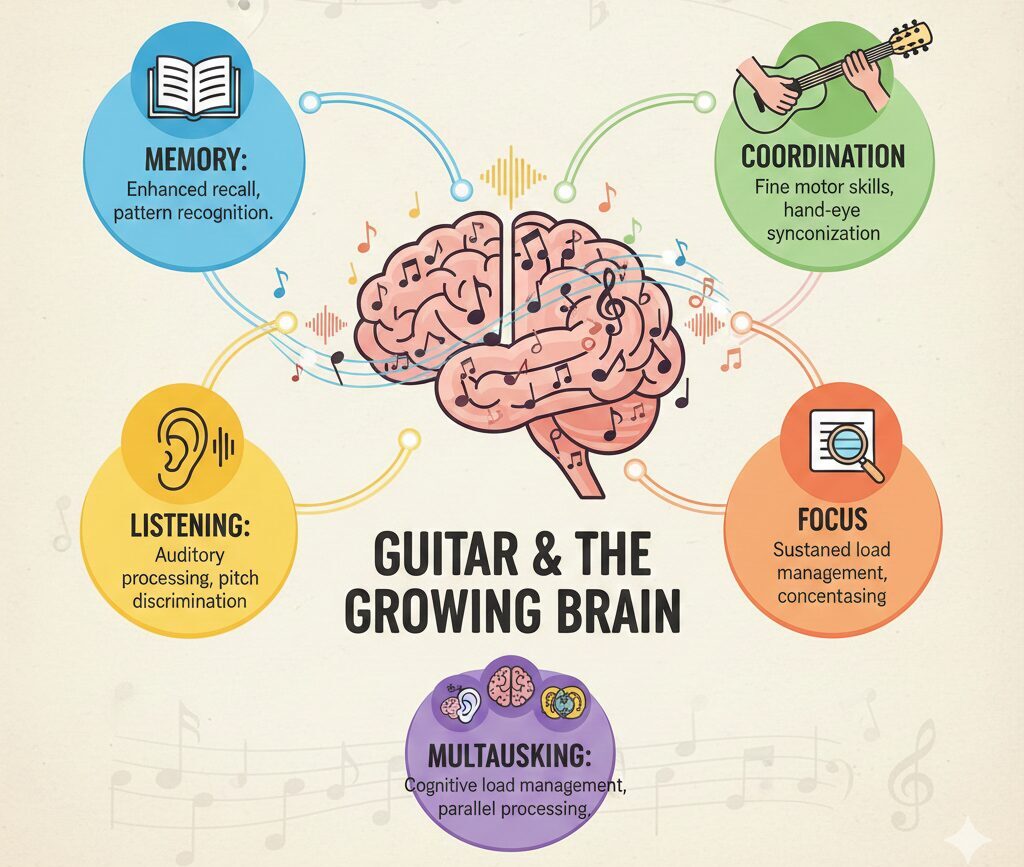
Learning a musical instrument has a direct and measurable impact on how the brain functions, and learning how to play guitar is no exception. When beginners practice guitar, they activate multiple areas of the brain at the same time. The brain processes rhythm, sound, movement, and timing together, which strengthens overall neural connections. This type of mental engagement supports long term brain development rather than short bursts of stimulation.
One of the most noticeable benefits of learning how to play guitar is improved memory. Guitar practice requires remembering chord shapes, strumming patterns, and song structures. Over time, this repeated recall strengthens both short term and long term memory. This mirrors the principles behind effective learning strategies discussed in the science of learning, where repetition combined with meaningful practice leads to lasting understanding rather than surface memorization.
Coordination also improves significantly. Learning how to play guitar requires the hands to perform different actions simultaneously while staying in rhythm. This hand to brain coordination sharpens motor skills and improves reaction time. These skills are especially useful for students and professionals who rely on precision and multitasking.
Listening skills are another major benefit. Guitar learners train their ears to recognize pitch, timing, and tone. This improves attention to detail and auditory processing. Focus and patience naturally develop because progress depends on consistent, attentive practice rather than quick results.
These cognitive benefits extend far beyond music. Students often see improvements in concentration and academic performance. Professionals benefit from better focus, problem solving, and stress management. Learning how to play guitar becomes a tool for overall mental growth, not just a musical skill.
Conclusion
Learning how to play guitar is a rewarding journey that builds creativity, discipline, and confidence. For beginners in 2026, success depends on learning the right things in the right order with proper guidance.
With structured lessons, consistent practice, and a standard tutor, beginners can avoid common mistakes and enjoy real progress.
Ready to Learn With Educify?
If you are serious about learning and want structured guidance, Educify is here to support you. While you can start your musical journey with guitar, we also offer language courses including French and other subjects designed to build valuable life skills.














4 Responses