
Choosing the best programming language to learn can feel overwhelming, especially if you are just starting out. A quick search online brings endless opinions, rankings, and trends, many of which contradict each other. Some say Python is the best programming language for beginners. Others insist JavaScript is unavoidable. Then you hear about Java, C++, Go, Rust, and suddenly the decision feels heavier than it should.
The truth is that there is no single best programming language for everyone. The best programming language depends on what you want to build, how you think, and where you want your skills to take you. This guide is designed to help you make that decision clearly and confidently.
Before ranking the best programming language options available today, it is important to understand what coding really is and what beginners actually need to succeed.
What Is Coding and Why Does It Matter?
Before choosing the best programming language, you need to understand what coding really means. Coding is the process of giving instructions to a computer so it can perform specific tasks. These instructions are written in programming languages that computers can interpret and execute.
When you write code, you are essentially solving problems. You break a problem into steps, express those steps clearly, and tell the computer exactly what to do. Coding is not about memorizing syntax. It is about logic, structure, and decision making.
Coding matters because almost everything we use today runs on software. Websites, mobile apps, banking systems, medical devices, data analysis tools, and artificial intelligence systems all rely on code. Learning the best programming language for your goals opens doors to careers in technology, business, science, and creative fields.
Understanding how coding works also improves problem solving skills. Many learners notice that coding trains them to think more clearly and logically, similar to the learning principles explained in the science of learning, where active engagement leads to deeper understanding rather than surface memorization.
Now that you understand what coding is, let us explore the best programming language options and what each one is actually good for.

How We Ranked the Best Programming Language Options
This ranking of the best programming language choices is based on real beginner needs, not hype. Each language is evaluated based on:
- Ease of learning for beginners
- Real world applications
- Career opportunities
- Community support and learning resources
- Long term relevance
The goal is not to crown a single winner but to help you find the best programming language for your specific path.
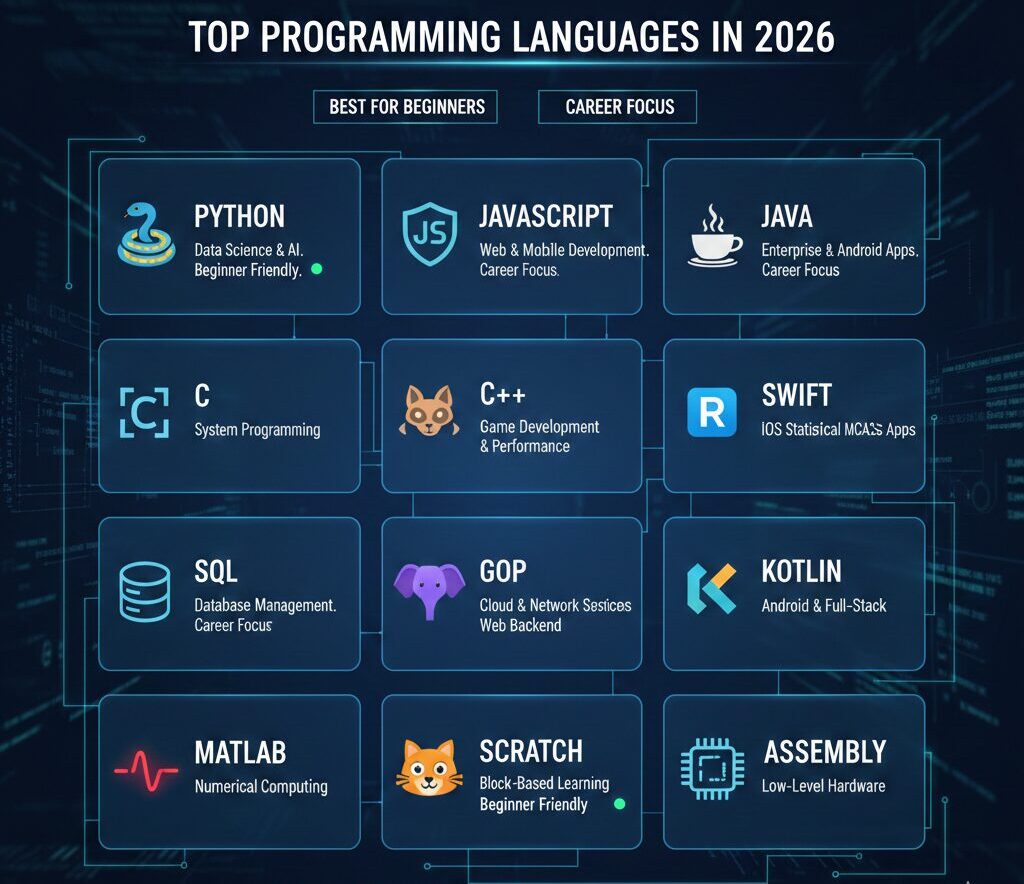
1. Python: Best Programming Language for Beginners and Data Analysis
Python consistently ranks as the best programming language for beginners, and for good reason. Its syntax is clean, readable, and close to plain English. This allows beginners to focus on problem solving instead of fighting complex syntax.
Python is widely used in data analysis, machine learning, artificial intelligence, automation, and scientific computing. If you want to work with data, Python is often the best programming language to start with. Libraries like Pandas, NumPy, and Matplotlib make data manipulation and visualization accessible even to beginners.
Python is also popular in education, which means learning resources are abundant. Beginners can build useful projects quickly, which boosts motivation and confidence. Another advantage of Python is how quickly beginners can build useful projects. You can automate tasks, analyze datasets, or create simple applications early in your learning journey. This builds confidence and keeps motivation high.
Python pairs well with foundational problem solving skills such as those taught when learning data structures and algorithms, making it a strong long term choice.
2. JavaScript: Best Programming Language for Web Development
If your goal is to build websites or web applications, JavaScript is one of the best programming language options available. JavaScript runs in the browser, which means it controls how websites behave and respond to user actions.
JavaScript allows beginners to see results quickly. You write code and immediately see changes on a webpage. This instant feedback makes learning engaging and practical. Beyond basic websites, JavaScript powers complex web applications, mobile apps, and even backend servers through tools like Node.js. This versatility makes JavaScript a strong career focused choice.
While JavaScript can feel confusing at first, structured learning helps beginners avoid common mistakes and build skills gradually, similar to how active learning emphasizes doing rather than passive watching.
3. Java: Best Programming Language for Enterprise and Stability
Java has been around for decades and remains one of the best programming language choices for large scale systems. It is widely used in enterprise software, Android development, and backend systems.
Java teaches strong programming fundamentals such as object oriented programming, data structures, and memory management. These concepts transfer well to other languages, making Java a solid foundation. For beginners, Java can feel more verbose than Python, but this structure helps learners understand how software systems are built. Many universities still teach Java because it reinforces disciplined coding habits.
If your goal is long term career stability in large organizations, Java remains one of the best programming language options to consider.
4. C: Best Programming Language for Understanding How Computers Work
C is often considered the best programming language for learning how computers actually operate. It is close to hardware and gives learners insight into memory management, performance, and system level programming.
C is used in operating systems, embedded systems, and performance critical applications. While it is not the easiest language for beginners, it provides deep understanding that strengthens all future programming learning.
Beginners who learn C often develop strong problem solving skills because the language forces precision and clarity. This aligns with study techniques that emphasize deliberate practice and attention to detail.
C may not be the fastest path to building apps, but it builds a strong technical foundation.
5.C++: Best Programming Language for Performance and Game Development
C++ builds on C and adds higher level features while maintaining performance. It is widely used in game development, graphics engines, and high performance applications.
For beginners interested in games or systems programming, C++ can be the best programming language choice. It teaches memory management, optimization, and complex problem solving.
C++ has a steeper learning curve, but learners who stick with it gain skills that are highly valued in specialized industries.
6. R: Best Programming Language for Statistics and Research
R is one of the best programming language options for statistical analysis and academic research. It is widely used by statisticians, data scientists, and researchers.
R excels at data visualization and statistical modeling. If your goal is research or data focused work, R can be the best programming language for that path.
However, R is more specialized than Python, which is why many beginners choose Python first and add R later depending on their needs.
7. Go: Best Programming Language for Modern Backend Systems
Go, also known as Golang, is a newer language designed for simplicity and performance. It is widely used in cloud services, networking, and scalable backend systems.
Go is easier to learn than many system level languages and has clear syntax. Beginners who want to work with backend services often find Go to be the best programming language for modern infrastructure. Its simplicity encourages good coding habits and clean design.
8. Rust: Best Programming Language for Safety and Reliability
Rust is known for its focus on memory safety and reliability. It prevents many common programming errors at compile time.
Rust is becoming popular in systems programming, blockchain, and security focused applications. While it is not the easiest language for beginners, it is one of the best programming language options for those who value safety and correctness.
Rust rewards careful thinking and structured learning.
9. Swift: Best Programming Language for Apple Development
Swift is the best programming language for developing apps for Apple devices such as iPhones and Macs. It is modern, fast, and designed to be beginner friendly compared to older Apple languages.
If your goal is mobile app development within the Apple ecosystem, Swift is the clear choice.
10.SQL: Best Programming Language for Working With Data
SQL is often overlooked, but it is one of the best programming language skills for working with databases. SQL allows you to retrieve, organize, and analyze data efficiently.
Almost every application relies on databases, which makes SQL a valuable complementary skill. Beginners often learn SQL alongside another language like Python or JavaScript.
11. PHP: Best Programming Language for Server Side Web Development
PHP is one of the most widely used server side languages on the internet. It powers a large percentage of websites, including platforms like WordPress. For beginners interested in how websites handle data behind the scenes, PHP can be a practical best programming language choice.
PHP is mainly used to manage databases, handle form submissions, manage user accounts, and control dynamic website content. If you have ever logged into a website or submitted an online form, PHP was likely involved.
One advantage of PHP is accessibility. Many hosting providers support it by default, making it easy for beginners to deploy real projects. While PHP is not as trendy as some newer languages, its real world demand remains strong, especially in content driven and small business websites.
12. Kotlin: Best Programming Language for Modern Android Development
Kotlin is now the preferred language for Android app development. It was designed to fix many of the frustrations developers experienced with Java while keeping compatibility with existing Android systems.
For beginners who want to build mobile apps, Kotlin can be the best programming language because it reduces boilerplate code and minimizes common errors. It is more concise than Java, which makes programs easier to read and maintain.
Kotlin also supports modern programming features that help learners write safer and more expressive code. If your goal is mobile development, especially for Android, Kotlin is a smart long term choice.
13. MATLAB: Best Programming Language for Engineering and Scientific Computing
MATLAB is widely used in engineering, physics, mathematics, and scientific research. It excels at numerical computing, simulations, and data visualization.
For beginners in technical or academic fields, MATLAB can be the best programming language for modeling real world systems. Engineers use it to simulate circuits, analyze signals, and solve complex equations.
MATLAB is less focused on general software development and more on computation and analysis. If your background is science or engineering, it provides tools that simplify complex mathematical tasks.
14. Scratch: Best Programming Language for Absolute Beginners and Kids
Scratch is a visual programming language designed to introduce coding concepts without overwhelming syntax. Instead of typing code, users drag and drop blocks that represent instructions.
For beginners who feel intimidated by traditional coding, Scratch can be the best programming language to start with. It teaches logic, sequencing, loops, and problem solving in a very approachable way.
Scratch is especially useful for younger learners or adults who want to build confidence before transitioning to text based programming languages like Python or JavaScript.
15. Assembly Language: Best Programming Language for Understanding Low Level Computing
Assembly language operates very close to the hardware. It gives programmers direct control over memory, registers, and processor instructions.
While Assembly is not beginner friendly in the traditional sense, learning its basics can deepen understanding of how computers actually execute programs. For learners interested in computer architecture, cybersecurity, or performance optimization, Assembly can be the best programming language for insight rather than productivity.
Most beginners do not start with Assembly, but even limited exposure can strengthen understanding of higher level languages.
How Beginners Should Choose the Best Programming Language
Choosing the best programming language depends on your goals:
- For data analysis and automation, Python is often the best programming language
- For web development, JavaScript is essential
- For enterprise systems, Java remains strong
- For systems and performance, C and C++ are valuable
- For research, R excels
What matters most is starting with one language and learning it well. Jumping between languages slows progress and causes confusion.
Structured learning plays a huge role here. Many beginners fail not because the language is hard, but because the learning path is unclear. Following guided lessons, practicing regularly, and building small projects leads to steady improvement.
Read Also: Data Structures & Algorithms: 6 Unbeatable Platforms to Level Up Your Coding
Why Structured Learning Matters When Learning Programming
Learning the best programming language is not just about content availability. It is about progression. Random tutorials often leave gaps in understanding.
Structured learning ensures that concepts build on each other logically. This reduces frustration and helps learners apply knowledge effectively.
This approach mirrors how effective learning works across disciplines, as explained in articles like how your brain learns, where consistent practice and feedback produce lasting results.
Conclusion
There is no single best programming language for everyone. The best programming language is the one that aligns with your goals, learning style, and long term plans.
Whether you choose Python, JavaScript, Java, or another language, success comes from consistency, structure, and practice. Learning programming is a skill that grows over time, not overnight.
Ready to Learn Programming the Right Way?
If you want to learn programming with clear structure, practical guidance, and beginner friendly explanations, Educify is here to support you. Our programming tutorials are designed to help learners understand concepts deeply and apply them confidently.
Start learning programming with Educify today and build skills that open real opportunities.

Frequently Asked Questions About Programming Languages
1. Which is the hardest coding language?
The hardest programming language depends on learning style, but Assembly and C++ are widely considered difficult. They require a strong understanding of memory, hardware interaction, and low level logic. Beginners often find them challenging because small mistakes can cause serious errors.
2. Who earns more, C++ or Python?
On average, C++ developers often earn slightly more than Python developers, especially in fields like game engines, embedded systems, and high performance software.
Typical salaries:
- Python developer: $90,000 to $140,000 per year
- C++ developer: $100,000 to $160,000 per year
Earnings depend heavily on industry, experience, and location.
3. Which coding is best for salary? (USD)
Languages linked to high paying roles include:
- Rust: $120,000 to $180,000
- Go: $110,000 to $170,000
- Java: $100,000 to $160,000
- Python: $90,000 to $150,000
The best salary often comes from combining a language with in demand skills like cloud computing or data engineering.
4. What’s better, C++ or Python?
Neither is better in all cases. Python is easier to learn and better for beginners, automation, data analysis, and AI. C++ is better for performance critical software like games, operating systems, and real time systems. The better choice depends on your goals.
5. What’s the best programming language for web development?
For web development, the most practical choices are:
- JavaScript for front end and full stack development
- Python for backend using frameworks like Django
- PHP for content driven websites
JavaScript stands out because it works across browsers, servers, and modern frameworks.





2 Responses