

Introduction
Web development has become one of the most valuable skills in today’s digital economy. In the US and Canada, companies, startups, and even independent entrepreneurs are constantly looking for developers who can create websites and web applications that attract and engage users.
For beginners, the idea of learning coding might feel overwhelming, but the rewards are significant: job opportunities, remote work options, and the potential for freelancing income. This guide will walk you step by step through everything you need to know about how to become a web developer to confidently start your journey, from understanding the basics to building real projects.
What Is Web Development?
Web development is the process of creating websites and web applications that people interact with daily. At its core, it combines programming, design, and problem-solving to bring ideas to life online. Websites, like news portals or online stores, and web applications, like banking apps or social media platforms, are built by web developers to serve specific user needs. Every time you book a ride, shop online, or watch a video, a web developer makes it possible.
In the modern digital economy, web development is essential because almost every business or service relies on an online presence. Understanding how to become a web developer opens doors to building these everyday digital experiences. Whether creating a personal portfolio, a small business site, or a full-featured app, web development skills allow you to contribute to the online world meaningfully and start a rewarding career in technology.

What Does a Web Developer Actually Do?
A web developer’s daily work involves creating and maintaining websites or web applications that people use effortlessly. Some days, you might be designing interactive features on a web page, while other times, you are solving technical problems that ensure the site functions correctly.
Building a simple website is different from developing a complex application like an online store or a social media platform, but both require attention to detail, creativity, and problem-solving skills.
Web developers can work alone, in teams, or directly with clients, adapting to project needs. They troubleshoot errors, optimize performance, and ensure the digital experience is smooth for every user. Understanding how to become a web developer helps beginners see that the role is diverse and engaging, combining creativity with technical expertise. For many, this variety is what makes the career both challenging and rewarding.
Types of Web Developers You Can Become
When starting your journey to becoming a web developer, it helps to know the main types of web developers and what each focuses on. Choosing a path early can make learning more structured and goal-oriented.
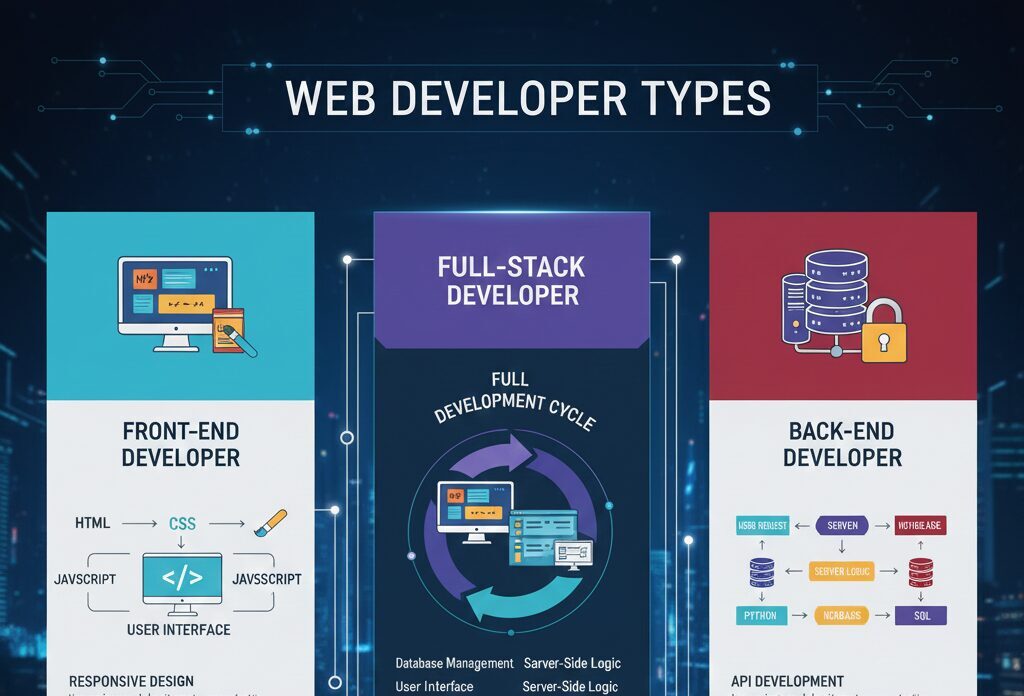
Front-End Developers
Front-end developers are responsible for everything users see and interact with on a website or application. They work with HTML to structure content, CSS to style pages, and JavaScript to add interactivity. For example, when you click a button, navigate menus, or watch animations on a page, front-end code is at work. This role suits beginners who enjoy design, user experience, and immediate visual results from their code.
Back-End Developers
Back-end developers handle the behind-the-scenes processes that make a website functional. They work with servers, databases, and APIs to store and manage data. If a website needs to save user accounts, process payments, or deliver personalized content, back-end developers make it happen. While this path is more logic-driven, it offers critical understanding of how web applications operate.
Full-Stack Developers
Full-stack developers combine front-end and back-end skills, managing entire projects from interface to server. This path requires broader knowledge but opens more job opportunities. Beginners might find full-stack learning overwhelming initially, so starting with either front-end or back-end is often more practical.
For those just starting, front-end development is a recommended entry point. It allows you to see results quickly, build confidence, and create projects you can showcase. Once comfortable, you can expand into back-end or full-stack roles. Learning how to become a web developer step by step ensures you progress efficiently without getting lost in unnecessary complexity.
Who Can Become a Web Developer?
The good news is that nearly anyone can become a web developer. You do not need a formal degree in computer science, though it can help in some cases. Many successful developers have started from completely different fields, proving that age, background, or career history is not a barrier.
Beginners with no technical experience can learn step by step, especially with structured guidance. Students, professionals looking to switch careers, freelancers, and entrepreneurs all have paths to entering web development. The key is commitment, practice, and curiosity rather than raw talent.
Understanding how to become a web developer emphasizes that skills matter more than credentials. Learning programming, problem-solving, and digital design can be achieved through courses, self-study, and mentorship. With dedication, even someone starting from scratch can move from their first line of code to a full-fledged career in web development, opening doors to high-demand jobs in the US and Canada.
Benefits of Becoming a Web Developer
Web development offers a wide range of benefits, making it an attractive career choice in the US and Canada. Job opportunities are growing rapidly as businesses, startups, and entrepreneurs need websites and web applications to reach customers. Developers can work remotely, in hybrid setups, or on-site, providing flexibility for different lifestyles.
Freelancing is another appealing aspect. With web development skills, you can earn side income or even start your own business offering website design, maintenance, or custom applications. Over time, as your expertise grows, salary progression can be substantial, especially in specialized areas like React or Node.js development. Long-term career security is strong because technology continues to evolve and digital presence remains essential for organizations.
For beginners, web development also fosters valuable skills that go beyond coding. Communication, problem-solving, project management, and creativity are part of the daily work. If you want to explore broader career advantages, check out 6 Essential Skills for the Future Job Market in the United States, which highlights how tech expertise fits into future-ready careers.
What Skills Do You Need to Become a Web Developer
Becoming a successful web developer requires a mix of technical and soft skills. On the technical side, the foundation includes HTML, CSS, and JavaScript. These allow you to structure pages, style them, and add interactivity.
Once comfortable, learning frameworks like React for front-end development or Node.js and Express for back-end work will make building applications faster and more efficient. Familiarity with version control tools like Git and platforms like GitHub is essential for collaboration and managing projects.
Soft skills are just as important. Problem-solving, patience, and communication play a key role in delivering high-quality work. Web developers often work in teams or with clients, so the ability to explain technical ideas clearly is invaluable. Time management and self-motivation are crucial, especially for freelancers or remote workers.
Tools and platforms are part of the daily routine. Integrated development environments (IDEs), browser developer tools, and databases like MongoDB or SQL are fundamental to building and testing applications. Beginners should also adopt a growth mindset, understanding that challenges and mistakes are part of learning.
Understanding how to become a web developer is more than coding. It is a combination of mastering technologies, refining problem-solving abilities, and continuously learning to adapt to new tools. For those looking to strengthen their programming foundation, resources likeData Structures & Algorithms: 6 Unbeatable Platforms to Level Up Your Coding can provide structured guidance and practice.
Step 1 – Learn the Foundations of Web Development

The first step in learning how to become a web developer is mastering the foundational technologies: HTML, CSS, and JavaScript. HTML is used to structure web pages, defining headings, paragraphs, buttons, and forms.
It is the skeleton that holds your content together. CSS adds style, color, spacing, and layout, transforming plain pages into visually appealing designs. JavaScript introduces interactivity, enabling features like form validation, dynamic content updates, and animations.
Beginners should approach these basics by focusing on practical exercises rather than memorizing every detail. Start small by building simple web pages and gradually add complexity. Online tutorials and coding platforms provide step-by-step exercises that reinforce learning. Avoid the common mistake of over-studying basics for months; it is more effective to learn the core 20 percent of concepts that cover 80 percent of practical use cases.
For additional structured guidance, resources like How to Learn Python From Scratch in 2026: A Practical Roadmap For Beginners can supplement your understanding of programming logic, and set you up to become a web developer.
By solidifying these fundamentals, you create a strong base to progress to frameworks and project development. Mastery of these tools is essential before moving on, ensuring that future learning is faster and more productive.
Step 2 – Learn Modern Front-End Tools and Frameworks
Once you have a strong grasp of HTML, CSS, and JavaScript, the next step in learning how to become a web developer is exploring modern front-end tools and frameworks. Frameworks simplify development by providing pre-written code and structured approaches, allowing you to build websites and applications faster and more efficiently.
For CSS, frameworks like Tailwind CSS make styling easier by offering ready-to-use classes that handle spacing, colors, and layout. This reduces repetitive work and keeps your code organized. For JavaScript, libraries like React are widely used in the industry to create dynamic user interfaces.
React breaks pages into reusable components, making it easier to maintain and scale projects. It is one of the most in-demand skills in the job market, giving beginners a clear advantage when applying for roles.
Structured learning is crucial. Following tutorials, practicing small projects, and gradually increasing complexity will help you gain confidence quickly. For practical guidance, resources like From Browser to Server: A Clear Guide to JavaScript Nodes for Learners provide step-by-step instructions to connect front-end development with server-side concepts.
Step 3 – Practice by Building Real Projects
After learning the basics and modern frameworks, the most important step in learning how to become a web developer is hands-on practice through real projects. While tutorials teach concepts, projects help you apply knowledge, solve problems, and gain confidence in building functional websites and applications.
Start with beginner-friendly projects like a personal portfolio site, a to-do list app, or a basic clone of a popular platform. These projects allow you to practice HTML, CSS, JavaScript, and frameworks like React while producing tangible results you can showcase to potential employers. As you progress, move on to more complex applications that involve interactivity, databases, and APIs.
Building projects also helps you develop problem-solving skills, understand debugging, and learn how to manage code efficiently. Unlike certificates, a portfolio of completed projects demonstrates your abilities in a real-world context.
At Educify, mentors guide students through projects, offering feedback and helping solve challenges along the way. This structured approach ensures beginners don’t get stuck or overwhelmed while practicing. Projects are where theory becomes reality, and consistent practice accelerates the journey to becoming an employable web developer.
Step 4 – Understanding Back-End Development
After gaining confidence with front-end development, the next step in how to become a web developer is understanding the back end. The back end powers everything that users do not see but experience indirectly, such as saving data, processing requests, and managing content dynamically.
Back-end development involves working with servers, databases, and APIs. Servers handle requests from users, databases store and retrieve data, and APIs act as bridges between the front end and back end. For example, when a user logs into an application, the front end collects the login information, sends it to the server through an API, and the back end verifies the credentials using the database.
Some developers choose to focus only on front-end work, while others expand into full-stack development to manage both ends. For beginners, front-end skills are sufficient to land a first job, but learning back-end concepts enhances career prospects and enables you to build complete applications.
Using JavaScript on the back end with Node.js and Express simplifies learning because it aligns with the front-end skills you already know. For practical guidance and project-based learning, check out Data Structures & Algorithms: 6 Unbeatable Platforms to Level Up Your Coding, which strengthens programming foundations critical for back-end work.
Understanding back-end development ensures your applications are not just visually appealing but fully functional and ready for real-world use.
Step 5 – Creating a Portfolio That Gets Attention
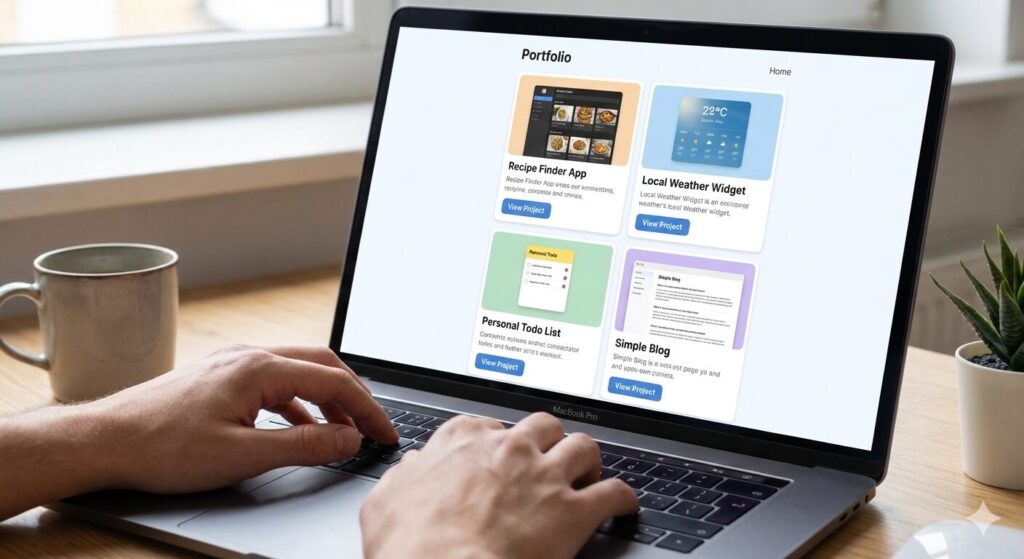
A strong portfolio is essential when learning how to become a web developer. It showcases your skills, creativity, and ability to solve real problems. A portfolio should include your best projects, demonstrating front-end and back-end work, interactivity, and clean design. Recruiters and clients look for practical examples of your capabilities, not just certificates.
Even a few well-executed projects can make a significant impact. Include descriptions of each project, the technologies used, and the challenges you solved. A polished portfolio signals professionalism and readiness for employment or freelance opportunities.
How Long Does It Take to Become a Web Developer
The time it takes to learn to become a web developer varies based on your learning pace and commitment. Beginners studying full-time can reach a job-ready level in around six to twelve months, while part-time learners may take 12 to 18 months.
Consistency matters more than speed; dedicating small, focused time daily is more effective than occasional long sessions. Guided learning with mentors and structured paths, like those offered at Educify, can significantly shorten the journey. Staying consistent and building real projects ensures steady progress and prepares you for professional opportunities efficiently.
Common Challenges Beginners Face and How to Overcome Them
Learning how to become a web developer can feel overwhelming. Beginners often struggle with too many resources and conflicting tutorials, which can lead to confusion. Getting stuck in repetitive tutorial loops without building real projects is another common challenge. Losing motivation during difficult concepts, like debugging or learning back-end logic, can slow progress.
The key to overcoming these obstacles is structured learning and guided practice. Following a clear path from basics to advanced projects ensures steady progress. Mentorship is invaluable; live guidance allows beginners to ask questions, get feedback, and avoid common pitfalls. Setting achievable goals and celebrating small wins keeps motivation high.
For example, building a small project daily or weekly, instead of focusing solely on theory, reinforces learning. Resources like Best Coding Websites to Learn DSA in a Fun Way provide practical exercises that strengthen problem-solving skills while keeping learning engaging.
Conclusion
Becoming a web developer opens doors to a rewarding and flexible career in the digital economy. With the right skills, consistent practice, and real-world projects, beginners can confidently move from learning the basics to building professional applications.
By following a structured path and overcoming common challenges, anyone can achieve their goal of becoming employable in the tech industry. The journey may require patience, but the opportunities are well worth the effort.
Learn Web Development With Educify!
Start your journey to becoming a web developer with Educify. Our live 1-on-1 and group tutorials guide beginners from fundamentals to job-ready skills. With structured learning paths, real projects, and expert mentorship, you can gain the confidence and skills needed to succeed in tech.






4 Responses