

Introduction
Why Bass Guitar Scales Matter More Than You Think
Many beginners hear the word scales and immediately switch off. Why? It probably sounds academic, slow, and disconnected from the reason they picked up the bass in the first place. The truth is that bass guitar scales are not a theory exercise you tolerate before getting to the fun part, they are the reason your bass lines sound intentional instead of accidental.
Every strong bass line is built on controlled note choices. When you understand bass scales, you stop guessing where to place your fingers. You begin to hear why certain notes support the groove while others weaken it. Scales guide your timing, your movement across the fretboard, and how you connect one note to the next without losing the pocket.
Playing random notes can work briefly, but it limits growth fast. Scales give you a map. They show you which notes belong together and how to move confidently without breaking the rhythm. This is especially important on bass, where your role is foundation, not flash.
In this guide, you will learn what scales actually do, how to use them musically, and how bass guitar scales translate directly into real bass lines you can play with other musicians.

What Bass Guitar Scales Really Are (Without Music Theory Overload)
Bass guitar scales are organized groups of notes that work together musically when played in a specific order or pattern on the fretboard. Instead of seeing scales as abstract theory, it helps to think of them as a practical note selection system that tells your fingers where to go and your ears what will sound stable. When you understand this, scales stop feeling intimidating and start feeling useful in real playing situations.
On bass, scales function differently than they do on lead instruments because your primary role is support rather than constant melodic movement. Bass players use scales to outline harmony, reinforce rhythm, and create movement without drawing attention away from the song. This is why bass scales are less about running notes up and down and more about knowing which notes to choose at the right moment.
A scale also acts as a navigation tool across the fretboard. When you learn one scale shape, you are not memorizing isolated notes, but building a repeatable pattern that can be moved to different positions. This pattern-based approach is why bass guitar scales feel consistent once you understand them, even when the key changes.
Another important idea is that scales are not rules that limit creativity. They are frameworks that reduce uncertainty. When you know which notes belong together, you gain confidence to play with better timing, cleaner transitions, and stronger note placement. This removes the fear of hitting wrong notes while staying locked into the groove.
For beginners who feel lost when improvising or writing bass lines, scales solve a very specific problem. They turn the fretboard from a confusing grid into a familiar map that supports musical decisions instead of forcing guesswork.
Understanding Notes on the Bass Fretboard First
Before diving into major and minor bass scales, it is essential to develop a clear understanding of the notes on your bass fretboard, as this knowledge forms the foundation for confident playing. Many beginners struggle because they try to memorize scale patterns without recognizing the underlying note layout, which leads to confusion when moving between positions or keys. Developing fretboard awareness first ensures that each finger movement has a purpose and every note choice makes musical sense.
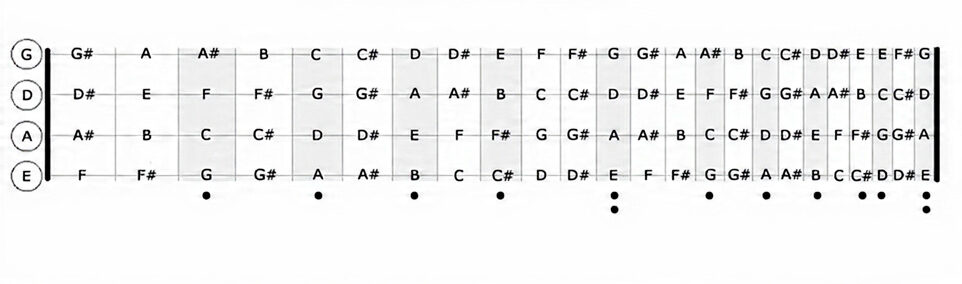
The bass guitar has four standard strings, tuned E, A, D, and G from lowest to highest. Each string repeats the notes at higher octaves, creating a consistent, predictable pattern that you can learn systematically. By understanding where each note lies across all four strings, you can begin to see the relationships between notes, which makes learning bass scales more intuitive and less about rote memorization.
One useful approach is to start with the open strings and practice naming the notes at each fret up to the twelfth fret. Once you are comfortable identifying these notes, you can begin to connect them into scale patterns. Recognizing the repetition of notes across strings allows you to shift scales to different positions without relearning them completely, which is a critical skill for real playing.
Finally, developing fretboard knowledge prevents reliance on visual memory alone. Instead of guessing where a note lies during improvisation, your fingers can move confidently based on sound and pattern recognition. This ensures that practicing bass guitar scales translates directly into the ability to play smooth, musical lines rather than just mechanical exercises. Mastering note placement is the first step toward turning scale knowledge into practical bass playing.
Major Bass Scales Explained Step by Step
Major bass scales are the backbone of many styles of music because they produce a bright, stable sound that supports melodies and chords effectively. Understanding the construction and use of major scales allows beginners to build bass lines that sound intentional, musical, and in harmony with other instruments. A major bass scale is not a random collection of notes but a carefully arranged sequence that creates a clear tonal center, known as the root, which everything else in the scale relates to.
The major bass scale formula follows a specific sequence of whole and half steps, which can be understood practically as a pattern rather than abstract theory. By memorizing this pattern, beginners can apply it starting from any root note on the fretboard. For example, the C major scale consists of the notes C, D, E, F, G, A, and B, which can be played in a single position to cover one octave. Playing this pattern repeatedly helps your fingers internalize the movement while reinforcing the sound of each scale tone.
Applying a major bass scale is not about running notes up and down mechanically. Instead, focus on connecting the root, third, and fifth notes to create grooves that support songs. For instance, playing a C major scale on the bass allows you to emphasize C as the root, E as the third, and G as the fifth while adding passing tones to make the line interesting without breaking the harmony.
Another example is the G major scale, which uses the notes G, A, B, C, D, E, and F sharp. Practicing this scale builds familiarity with the fretboard in a different position while maintaining the same pattern logic. By understanding one-position major scale patterns, beginners can quickly transpose them to other keys, which is essential for real-world playing where songs often change keys. Mastering major scales at this stage lays the foundation for creating grooves, fills, and walking bass lines that feel musical rather than forced.
To further support practical learning, you can explore How to Play Guitar for Beginners: Practical Steps That Actually Works to understand connecting scale theory to real instrument practice.
Minor Bass Scales Breakdown
Minor bass scales are essential for creating music that feels emotional, introspective, or dramatic, offering a contrast to the bright and stable sound of major scales. Understanding minor scales allows beginners to craft bass lines that evoke mood while remaining supportive of the song’s harmony. The minor bass scale is structured in a way that emphasizes tension and resolution, providing expressive possibilities without requiring complex theory knowledge.
The natural minor scale is the most approachable starting point for beginners. It follows a consistent step pattern that can be applied across the fretboard. For example:
A natural minor scale:
- A (root)
- B (major second)
- C (minor third)
- D (perfect fourth)
- E (perfect fifth)
- F (minor sixth)
- G (minor seventh)
E natural minor scale:
- E (root)
- F# (major second)
- G (minor third)
- A (perfect fourth)
- B (perfect fifth)
- C (minor sixth)
- D (minor seventh)
These patterns can be practiced in a single position to build finger familiarity and sound recognition. Beginners should focus on connecting the root, minor third, and fifth notes to create grooves that retain musicality. By including passing notes from the minor scale, your lines can become more expressive without losing structure.
Key differences between major and minor bass scales:
- Sound: Minor scales feel darker and more somber, while major scales feel bright and stable.
- Emotional role: Minor scales support emotional or introspective songs; major scales support upbeat or melodic sections.
- Application: Minor scales allow for tension in walking bass lines and fills, while major scales emphasize harmonic stability.
Practicing minor bass scales in this structured way allows beginners to hear and feel the distinction between scale types while building a foundation for real music application. For practical examples and applied exercises, consider reviewing Major vs Minor Guitar Scales: What’s the Difference? to see how scales translate across instruments and musical contexts.
Major vs Minor Bass Scales (How to Hear and Use the Difference)
Understanding the difference between major and minor bass scales is essential for creating bass lines that support the music’s emotional tone and harmony. Many beginners struggle to decide which scale to use because they focus only on finger patterns rather than the sound and feeling each scale produces. Recognizing the difference allows you to choose notes confidently and play with musical intent.

How major bass scales feel musically:
- Bright and stable, providing a sense of resolution.
- Supportive for melodies that are happy, uplifting, or neutral.
- Often emphasized in choruses and upbeat sections of songs.
How minor bass scales feel musically:
- Darker, more introspective, or tension-filled.
- Convey emotional depth, melancholy, or suspense.
- Frequently used in verses, bridges, or songs with reflective moods.
Tips for using major and minor scales effectively:
- Listen first: Play a root note and try both scale types to hear the difference.
- Anchor with the root: Always identify the tonic note before building your bass line.
- Start simple: Use the first three to five notes of the scale to construct grooves.
- Experiment with passing tones: Add additional scale notes gradually to create movement without breaking the harmonic support.
By practicing these distinctions, beginners can train their ear to hear whether a song calls for a major or minor approach. This skill translates directly into better musical decision-making and smoother integration into bands or backing tracks. Using bass scales intentionally rather than mechanically ensures that each line contributes to the song’s emotion and groove, making your playing feel purposeful from the first note.
For further context on applying scales practically across instruments, explore Guitar Chords Every Beginner Must Learn First, which illustrates the relationship between chord shapes and scale application.
How Bass Guitar Scales Fit Into Real Bass Lines
Understanding bass guitar scales is only part of the journey; applying them to real bass lines is what transforms practice into musical performance. Scales provide a framework, but the goal is to create grooves, fills, and rhythmic patterns that support the song while remaining interesting. Beginners often make the mistake of playing scales straight up and down, which rarely sounds musical. Learning to integrate scales into actual bass lines develops both technique and musicality.
Steps to applying scales in real bass lines:
- Identify the root note: Every bass line starts with the tonic of the chord or key. The root anchors your line and ensures harmonic support.
- Choose supporting scale tones: Use the third and fifth intervals to outline the chord, then add passing tones from the scale to create movement.
- Focus on rhythm first: The groove matters more than playing every note of the scale. Experiment with syncopation, rests, and note length to make lines feel alive.
- Connect patterns across positions: Once you understand the one-position scale shape, link it to adjacent positions on the fretboard to add versatility.
- Listen and adjust: Always play along with a backing track, drum pattern, or recording to ensure your line fits the song’s texture.
Example groove using a C major scale:
- Start with C (root) on the third fret of the A string.
- Move to E (third) and G (fifth) to outline the chord.
- Add D and F as passing notes to create movement.
- Play in sync with a simple drum pattern for a tight groove.
Example groove using an A minor scale:
- Anchor on A (root) on the fifth fret of the E string.
- Emphasize C (minor third) and E (perfect fifth).
- Include G (minor seventh) to add tension.
- Vary rhythm to emphasize beats 2 and 4 for a natural, musical feel.
Using these steps consistently ensures that bass scales are not abstract exercises but tools to build bass lines that groove, support the song, and engage listeners. This approach bridges the gap between learning patterns and creating music you can perform confidently.
One-Octave vs Two-Octave Bass Scales: What Should You Focus On?
When you begin to learn bass guitar scales, deciding between one-octave and two-octave patterns can feel confusing, but understanding the purpose of each helps prevent overwhelm. One-octave scales are simpler, easier to memorize, and provide a solid foundation for developing fretboard familiarity. Two-octave scales extend the range, offering more versatility, but they can be unnecessarily complex for beginners if attempted too early.
Why beginners should start with one-octave scales:
- Ease of memorization: Learning a single octave allows you to focus on finger placement and note recognition without jumping across strings unnecessarily.
- Fretboard orientation: One-octave patterns teach how notes repeat along the neck, establishing a mental map of the fretboard.
- Groove development: Practicing short scale patterns allows you to emphasize rhythm, timing, and musicality without becoming lost in movement.
When to incorporate two-octave scales:
- After mastering one-octave patterns and developing finger dexterity.
- When learning to play bass lines that span wider ranges or walking bass lines.
- To connect scale positions smoothly across the fretboard, improving versatility.
Even professional bass players rely heavily on simple, one-octave patterns, only expanding to two octaves when the musical context demands it. By focusing on one-octave scales first, beginners can build confidence, internalize scale shapes, and develop the ability to play grooves with precision. Attempting two-octave scales too early can lead to frustration, sloppy timing, and slower progress.
The key is to practice bass scales deliberately, mastering one-octave patterns and gradually expanding to longer scales as finger strength and fretboard awareness improve. This method ensures that every scale learned has a direct impact on musical ability and practical application.
How to Practice Bass Guitar Scales Effectively
Effective practice of bass guitar scales requires a structured and focused approach that balances technique, rhythm, and musical application. Many beginners struggle because they treat scales as abstract drills rather than tools to improve actual playing. A sustainable practice system ensures progress without creating frustration or burnout while allowing you to translate scale knowledge into real bass lines.
Daily routine recommendations:
- Time allocation: Spend 10–20 minutes per day focused solely on scales. Short, consistent sessions are more effective than long, irregular practice.
- Start slow: Begin with a tempo that allows every note to ring clearly and your fingers to move comfortably. Gradually increase speed while maintaining precision.
- Use a metronome: Practicing with a metronome reinforces timing, rhythm, and consistency, which are critical for integrating scales into grooves.
- Apply scales musically: Rather than running notes mechanically, create simple patterns, riffs, or grooves using the scale tones. This strengthens your ability to play musically and improvisationally.
- Focus on one scale at a time: Master one major or minor scale before moving to the next. Repetition with understanding is more valuable than attempting multiple scales superficially.
Practical exercises:
- Play the scale ascending and descending while emphasizing different notes, such as the root, third, or fifth.
- Experiment with rhythmic variations, including dotted notes, triplets, and syncopation, to develop versatility.
- Combine scales with simple backing tracks to simulate real musical contexts and reinforce practical application.
By following these steps, beginners can turn scale practice into a productive, engaging, and musical routine. Effective practice builds not only technical skill but also the confidence and intuition needed to apply bass scales in real playing situations.
Conclusion
Mastering bass guitar scales is not an optional step but a vital part of becoming a confident and musical bassist. Scales provide the framework for note selection, rhythm, and harmony, allowing you to create bass lines that groove, support songs, and convey emotion. Beginners who invest time in understanding and applying scales will notice immediate improvements in timing, fretboard navigation, and musical intuition.
Learn Bass the Right Way With Educify 🎸
At Educify, we provide structured, beginner-friendly guidance to help you learn bass scales efficiently and confidently. Through practical tutorials and step-by-step lessons, you can build your skills while keeping practice engaging and musically relevant.