
Introduction
Science doesn’t have to be messy, scary, or complicated. Hands-on experiments spark curiosity, teach critical thinking, and show kids how the world works in ways textbooks alone cannot. The best part? Many activities are completely safe, use household items, and can even feel like magic.
In this article, we share 10 weird science experiments for kids to try at home without breaking anything, each designed to entertain while teaching a real scientific principle. From fizzy eruptions to color-changing milk, these experiments encourage observation, problem-solving, and creative exploration.
Whether you’re a parent guiding a curious child or a student wanting fun learning at home, these experiments make science approachable, memorable, and endlessly enjoyable.

1. Fizzy Rainbow Eruption
Bring a colorful chemical reaction to life with this simple experiment. You only need baking soda, vinegar, and a few drops of food coloring. Start by placing baking soda in a cup or small container, then add a different color to each portion. When vinegar is poured over the soda, a fizzy eruption occurs, sending rainbow bubbles over the edge.
This is a science experiment for kids that introduces them to acids and bases, cause-and-effect relationships, and observation skills. They can predict which colors will fizz faster or mix to form new shades. It’s a hands-on way to learn how substances interact, showing that even basic kitchen ingredients can create exciting science magic.
2. Invisible Ink Messages
Kids can become secret agents with this easy chemistry trick. Using lemon juice and plain paper, they can write hidden messages. After writing, the paper looks blank. To reveal the message, carefully heat it over a light source, like a lamp or toaster (with adult supervision). The heat oxidizes the lemon juice, turning it brown and making the writing visible.
This is a science experiment for kids that teaches basic chemical reactions, oxidation, and careful observation. It encourages creativity while showing that science can be both playful and mysterious. Kids can try different natural liquids, such as orange juice or milk, to see how reactions vary.
3. Dancing Raisins
This fun science experiment for kids shows how carbon dioxide bubbles make raisins “dance” in a glass of carbonated water. Drop a few raisins into the fizzy water and watch as bubbles cling to the raisins, lifting them to the surface. When the bubbles pop, the raisins sink again, creating a continuous dance.
This activity introduces concepts like buoyancy, gas formation, and density in a hands-on way. It encourages observation, questioning, and curiosity. Kids can experiment with different liquids or small objects to see how density and carbonation affect movement.
4. Walking Water Experiment
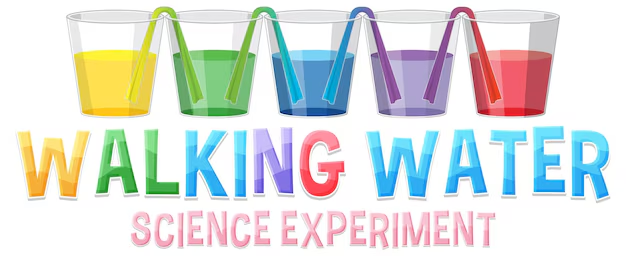
This science experiment for kids demonstrates capillary action and color mixing in a simple, visual way. Set up three cups in a row, fill the first and third with water, and add different food coloring. Place an empty cup between them and connect all cups using folded paper towels as bridges. Over time, the colored water “walks” along the paper towels, eventually mixing in the middle cup.
Kids learn how liquids move through porous materials, observe color blending, and develop patience as they watch the process unfold. It also encourages teamwork if done in groups and sparks questions about real-world applications like plant water transport.
5. Balloon-Powered Car
This science experiment for kids introduces basic physics concepts like motion, force, and air pressure. Using a balloon, straw, cardboard, and tape, children can create a simple car that moves when the balloon releases air. Inflate the balloon, attach it to the car, and watch as it propels forward.
It teaches cause and effect, encourages hands-on problem solving, and allows kids to modify their designs to see how changes affect motion. It’s a fun way to explore propulsion, energy transfer, and experimentation without any risk. Parents can guide students to measure distance or time, turning play into a learning opportunity.
6. Homemade Lava Lamp
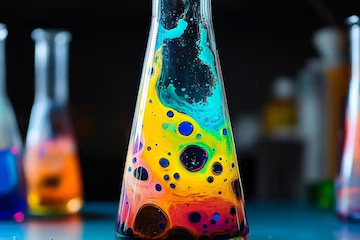
This science experiment for kids demonstrates density and polarity in liquids while creating a mesmerizing visual effect. Using oil, water, food coloring, and an Alka-Seltzer tablet, children can observe how the different liquids interact and how gas bubbles move through the layers.
Start by filling a clear container mostly with oil, add colored water slowly, then drop in a piece of Alka-Seltzer. Watch the bubbles rise and fall, carrying colored droplets through the oil. This teaches concepts like liquid density, chemical reactions, and immiscibility. Kids also learn patience and observation skills as they experiment with varying amounts of water, oil, or effervescent tablets.
7. Static Electricity Butterfly
This science experiment for kids explores static electricity in a fun, visual way. Using a balloon, tissue paper, and a wool cloth, children can make a paper butterfly’s wings flap without touching it.
First, cut a butterfly shape from tissue paper and place it on a flat surface. Inflate a balloon and rub it against wool or your hair to build static charge. Slowly bring the balloon near the butterfly’s wings and watch them rise or move as if alive.
This experiment demonstrates electrical charges, attraction, and repulsion in a hands-on way. Children also practice careful observation and cause-and-effect reasoning while enjoying a playful, safe activity.
8. Mini Tornado in a Bottle
This science experiment for kids brings fluid dynamics to life with a simple setup. Using two clear plastic bottles, water, and duct tape, children can create a mini tornado that swirls inside the bottle.
Fill one bottle about three-quarters full with water, tape it securely to an empty bottle, and flip them so the water bottle is on top. Swirl the top bottle in a circular motion and watch a vortex form as the water drains into the bottom bottle.
This activity illustrates circular motion, pressure differences, and vortex formation. It encourages kids to make predictions, observe patterns, and understand basic physics concepts safely and visually.
9. Color-Changing Milk
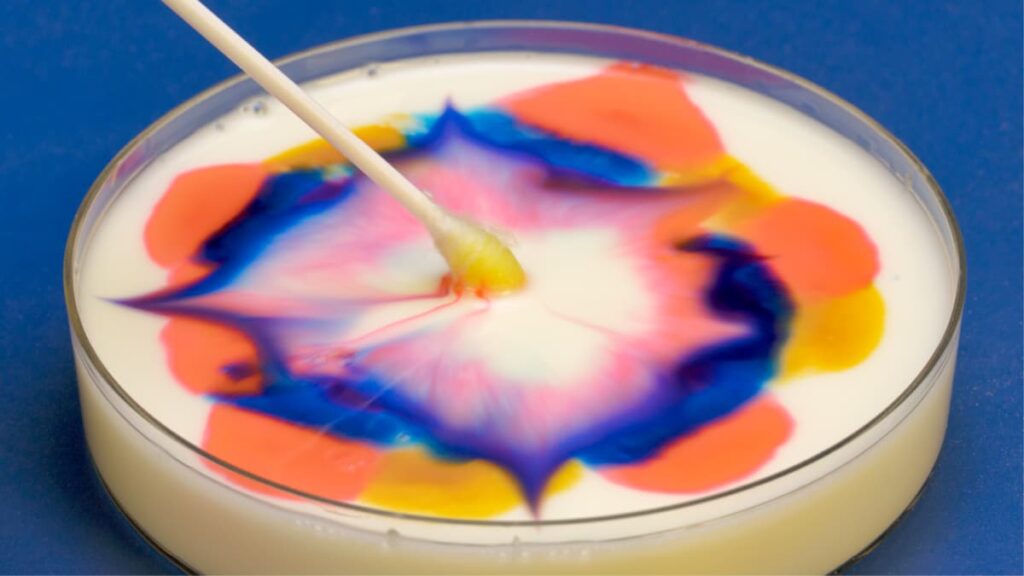
This science experiment for kids is a colorful way to explore surface tension and chemical reactions. Using simple household items like milk, food coloring, dish soap, and a cotton swab, children can see liquids interact in fascinating ways.
Pour milk into a shallow dish and add drops of different food coloring. Dip a cotton swab into dish soap and touch it to the center of the milk. Watch as the colors swirl dramatically without stirring.
This experiment demonstrates how soap breaks the surface tension of milk, allowing the colors to move. Kids learn about molecules, reactions, and cause-effect while having fun with visually engaging results.
10. Growing Crystal Garden
This science experiment for kids teaches patience and the basics of crystallization. With simple materials like salt or sugar, water, jars, and paper towels, children can grow their own crystal garden at home.
Start by dissolving salt or sugar in warm water until fully saturated. Place paper towels in jars and pour the solution over them. Over the next several days, crystals will begin to form along the paper towels. Kids can experiment with different solutions or colors to see how growth changes.
This activity teaches evaporation, supersaturation, and the science of crystal formation. It’s a hands-on way to reinforce observation, prediction, and curiosity while creating a tangible result.
Conclusion
Science can be fun, safe, and educational at the same time. These 10 science experiments for kids show that learning doesn’t have to be complicated or messy. From fizzy eruptions to growing crystals, each experiment encourages curiosity, critical thinking, and hands-on problem solving. Repeating experiments or trying small variations deepens understanding while keeping children engaged. Parents can use these activities to spark discussion, ask open-ended questions, and explore scientific principles together.
For more structured guidance, more interactive science experiments for kids, and expert support, explore Educify’s science programs, where qualified tutors make learning safe, exciting, and educational for every child.