
The world of online teaching is rarely still — and March 2026 is proving that in spectacular fashion. From award-winning educators pioneering creative digital methods, to the European Space Agency launching a global teacher conference, to fierce debates over foreign language requirements and the future of Mathematics, the e-learning landscape is shifting fast. If you teach, learn, or care about education online, here is what you need to know right now.
Table of Contents
- Award-Winning Educators Are Raising the Bar for Online Teaching
- The ESA Teach with Space Online Conference 2026
- Foreign Language Education Under the Spotlight
- Mathematics Online: Rigor, Innovation, and Controversy
- What These Developments Mean for Online Learners and Educators
- Key Statistics
- FAQ
Award-Winning Educators Are Raising the Bar for Online Teaching
Two stories broke this week that deserve every educator's attention.
At the University of Central Florida, a chemistry instructor was recognized with the Excellence in Online Teaching Award for a creative, student-centered approach to digital science education. Rather than simply replicating the traditional lecture format on a screen, the instructor redesigned course delivery from the ground up — integrating interactive simulations, asynchronous video content, and real-time problem-solving sessions that kept students genuinely engaged.
Meanwhile, at Oklahoma State University, accounting faculty member Rachel Cox earned the Oklahoma Online Excellence Award, recognized for her ability to make a subject often perceived as dry and complex feel accessible and relevant through thoughtful e-learning design.
"UCF Chemistry Instructor's Creative Approach Earns Excellence in Online Teaching Award"
— University of Central Florida
These recognitions are not just feel-good stories. They signal a broader shift in how institutions are evaluating online teaching quality — moving away from measuring "hours of content delivered" toward assessing learner engagement, outcomes, and pedagogical innovation.
"Excellence in online teaching is no longer about putting slides on a screen. It's about designing experiences that meet learners where they are." — A sentiment echoed across the e-learning community in 2026.
The ESA Teach with Space Online Conference 2026
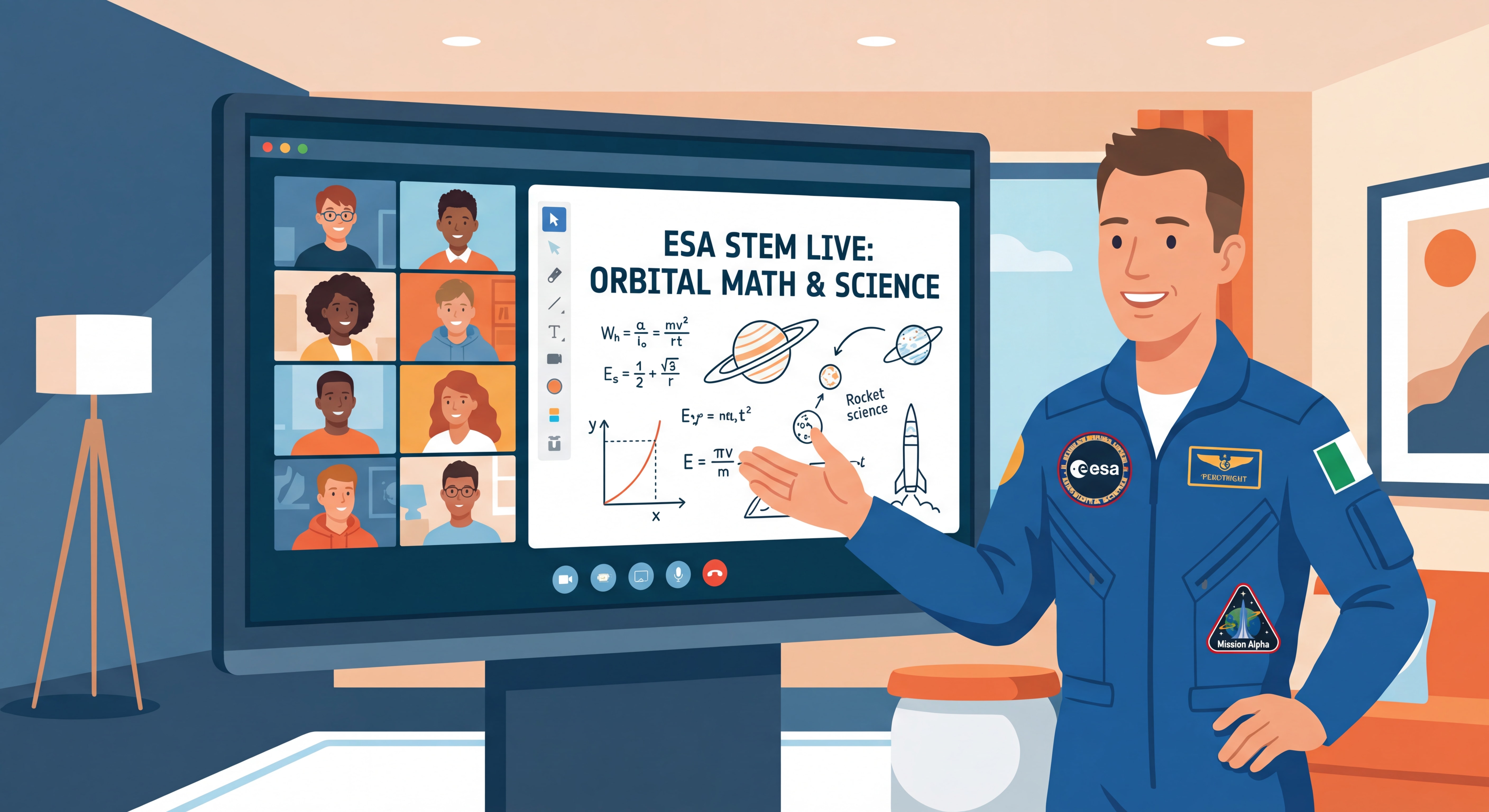
Perhaps the most exciting announcement of the week for educators worldwide: the European Space Agency (ESA) has officially opened registration for the Teach with Space Online Conference 2026, announced on March 27th.
This free, internationally accessible event brings together science and STEM educators from across the globe, offering workshops, resources, and direct engagement with ESA experts. The conference is specifically designed to help teachers integrate space science into their online and classroom curricula — covering subjects from physics and mathematics to geography and engineering.
"Join the ESA Teach with Space Online Conference 2026"
— European Space Agency
For online educators teaching Mathematics or the sciences, this is a rare opportunity. The conference offers:
- Ready-to-use digital resources aligned with national curricula
- Live Q&A sessions with ESA scientists and engineers
- Collaborative workshops for educators across different countries and languages
- Certificates of participation for professional development
This kind of global, cross-disciplinary initiative illustrates exactly where online education is heading: borderless, collaborative, and anchored in real-world relevance.
Foreign Language Education Under the Spotlight
Online language learning received a significant jolt this week when the Chicago Tribune published a pointed editorial urging Illinois not to retreat on foreign language education requirements. The piece comes amid reports that some school districts are quietly scaling back or eliminating mandatory language learning — a trend that educators and linguists are pushing back against firmly.
"Editorial: Illinois shouldn't retreat on foreign language education"
— Chicago Tribune
The timing is striking. Just days earlier, Google announced that its AI-powered live search assistant now handles conversations in dozens more languages — underscoring that multilingualism is not a relic of the past but a growing digital and professional necessity.
For online language teachers and platforms, this news cycle carries a clear message: the demand for accessible, high-quality language instruction is not shrinking — it's evolving. The question is whether educational institutions will keep pace with the tools and technologies that learners already have at their fingertips.
Key takeaways for language educators in 2026:
- AI tools are supplementing, not replacing, qualified language teachers
- Online platforms for language learning are seeing sustained growth, particularly for English, Spanish, Mandarin, and Arabic
- Institutions that cut language programs risk leaving students underprepared for a multilingual, global workforce
Mathematics Online: Rigor, Innovation, and Controversy
The Mathematics community is making headlines for more than just numbers this week.
Quanta Magazine reported on a growing debate within the mathematical community: as digitized proof-verification tools become more powerful, are they pushing mathematical rigor to an extreme that stifles creativity and intuition? Meanwhile, MIT Technology Review highlighted a startup actively working to transform how mathematicians collaborate and verify their work online.
And in a sobering moment for the community, the passing of Heisuke Hironaka — a Fields Medal-winning mathematician who revolutionized algebraic geometry — was announced this week. His work, celebrated globally, is a reminder of the profound human dimension behind the discipline.
"In Math, Rigor Is Vital. But Are Digitized Proofs Taking It Too Far?"
— Quanta Magazine
For online Mathematics educators, these developments translate into a practical challenge: how do you teach rigorous mathematical thinking in a digital environment without losing the spark of curiosity? The best e-learning platforms are responding by:
| Approach | Traditional Online Teaching | Innovative 2026 Approach |
|---|---|---|
| Problem solving | Static PDFs and quizzes | Interactive proof tools and AI feedback |
| Student engagement | Video lectures | Live collaborative problem-solving |
| Assessment | Multiple-choice tests | Open-ended digital projects |
| Teacher feedback | Weekly emails | Real-time annotation and chat |
The message is clear: Mathematics online teaching must evolve beyond content delivery into genuine intellectual engagement.
What These Developments Mean for Online Learners and Educators
Taken together, this week's news paints a coherent picture of where online teaching, e-learning, languages, and Mathematics are heading in 2026:
- Quality is being formally recognized. Awards for online teaching excellence signal that institutions are investing in — and rewarding — pedagogical innovation.
- Global collaboration is accelerating. Events like the ESA conference show that online education is uniquely positioned to connect educators and learners across borders.
- Language skills remain essential. Despite political pressures, the professional and digital case for multilingualism has never been stronger.
- Mathematics education must balance rigor with engagement. New digital tools are powerful, but the human element of teaching remains irreplaceable.
- Affordable access is expanding. Reports this week also noted that entrepreneurs can now access over 1,000 professional e-learning courses for a one-time fee — a sign that the cost barrier to lifelong learning continues to fall.
📊 Expected to exceed $400 billion globally by 2027 – Online Education Market Growth
📊 Over 500 million active users worldwide in 2026 – Language Learning Apps Usage
Key Statistics
📊 $400B+ — Projected global e-learning market value by 2027, reflecting explosive demand for online education (Global Market Insights, 2026)
🌍 500 million+ — Active users of online language learning platforms worldwide in 2026, with multilingualism increasingly tied to career success (Statista, 2026)
🎓 72% of higher education institutions now offer fully online degree programs, up from 53% in 2022 (EDUCAUSE, 2026)
📐 1 in 3 Mathematics students in OECD countries now uses a digital learning tool as their primary study resource (OECD Education at a Glance, 2026)
Frequently Asked Questions (FAQ)
What are the biggest trends in online teaching right now in 2026?
The most significant trends include the formal recognition of teaching excellence in digital environments, the rise of global collaborative events like the ESA Teach with Space Conference, AI-assisted language learning tools, and interactive Mathematics platforms that go beyond passive video content. Institutions are increasingly rewarding pedagogical innovation over simple content delivery.
Is online language learning as effective as in-person instruction?
Research consistently shows that well-designed online language courses can match or exceed in-person outcomes, particularly when they include live conversation practice, immediate feedback, and culturally rich content. The key differentiator is design quality — not the medium itself.
How can Mathematics be taught effectively online?
Effective online Mathematics teaching combines structured video explanations with interactive problem-solving tools, real-time feedback, and collaborative sessions. The 2026 trend is moving away from static quizzes toward open-ended digital projects and AI-powered tutoring that adapts to each learner's pace.
Are free or low-cost e-learning resources worth it?
Increasingly, yes. Platforms and events like the ESA's free teacher conference, combined with affordable course bundles now available to entrepreneurs and educators, mean that high-quality learning resources are more accessible than ever. The key is choosing programs with clear outcomes, qualified instructors, and active learner communities.
Why is foreign language education facing cuts, and what can be done?
Budget pressures and shifting curriculum priorities are driving some institutions to reduce language requirements. However, advocates — including major editorial boards and linguists — argue this is short-sighted given the growing demand for multilingual professionals in a globalized economy. Online language platforms offer a practical, scalable solution for schools and learners alike.
Conclusion
This week's wave of news makes one thing abundantly clear: online teaching is not a static field — it is one of the most dynamic and rapidly evolving areas of modern education. Whether you are an educator looking to sharpen your digital teaching skills, a language learner seeking the best online resources, or a Mathematics student navigating a changing landscape of digital tools, the opportunities available in 2026 are extraordinary.
The educators being recognized for excellence, the global conferences breaking down borders, and the passionate debates over language and Mathematics are all signs of a field that takes its mission seriously: to make quality education accessible to everyone, everywhere.
Ready to take your online learning or teaching to the next level? Whether you want to explore new e-learning platforms, discover the best online language courses, or find innovative ways to teach Mathematics digitally — we are here to help. Get in touch today to learn more about how to make the most of what online education has to offer in 2026.