Introduction
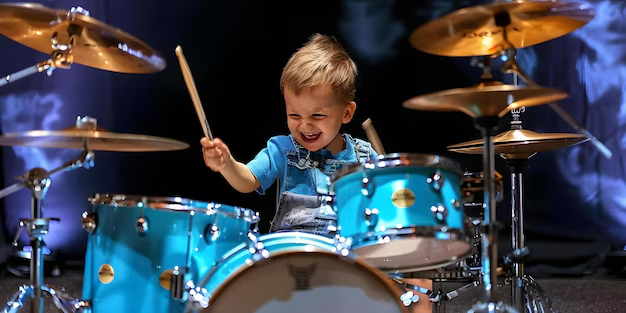
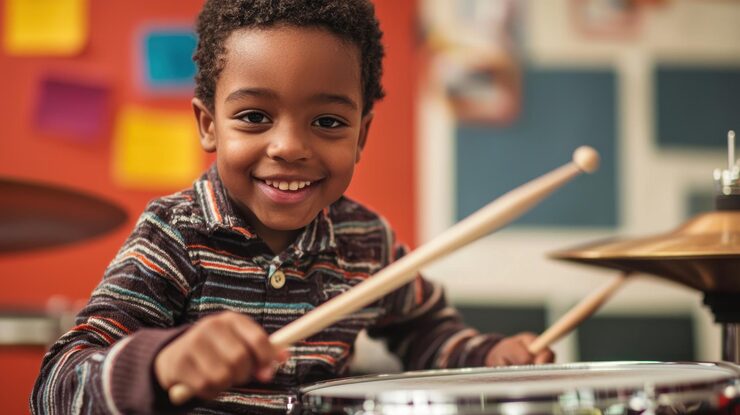
Hey there, future drumming legends! Whether you’re a parent cheering on your child’s new musical adventure or a student ready to unleash your inner rhythm, you’ve landed in the right spot. Here at Educify, we’re passionate about making learning an exciting and rewarding experience.
That’s why we’ve put together this guide to the best drumming exercises to kickstart your journey. Getting started with any new instrument can feel a little overwhelming, but with the right practice and a positive mindset, you’ll be laying down cool beats in no time.
This article is packed with drumming exercises for beginners that will help you build a strong foundation, improve your coordination, and boost your confidence. From simple hand movements to full-body coordination, these exercises are designed to be fun and effective. So, grab your sticks (or even just your hands for now!), and let’s dive into some drumming exercises that will have you drumming like a pro.
1. The Mighty Single Stroke Roll
Let’s start with the absolute foundation of all drumming exercises: the single stroke roll. It’s as simple as it sounds: alternating single hits with each hand (Right, Left, Right, Left). But don’t let its simplicity fool you; mastering the single stroke roll is a lifelong pursuit for even the most advanced drummers. The key here is consistency.
Aim for each stroke to have the same volume and for your sticks to reach the same height on each hit. A great way to practice this is with a metronome, starting at a slow tempo and gradually increasing the speed as you get more comfortable. You can do this on a practice pad, a pillow, or even a tabletop, making it one of the most versatile drumming exercises without drums.
Focusing on your single stroke roll will build hand speed, control, and endurance. It’s one of the most fundamental drumming exercises for beginners and will be a part of your practice routine forever. The evenness you develop here will translate to everything else you play, making your beats and fills sound clean and professional.

2. Doubling Down with Double Strokes
Once you’re feeling good about your single strokes, it’s time to introduce the double stroke roll. This exercise involves playing two strokes with each hand (Right, Right, Left, Left). The double stroke roll is where you’ll start to feel the “bounce” of the drumstick.
Instead of using your wrist for every single hit, you’ll learn to let the stick do some of the work. This is a more advanced technique, but it’s one of the most important drumming exercises for beginners to start working on early. A great way to practice this is to focus on the second hit of each double stroke. Try to make it as loud and clear as the first.
This can be tricky at first, but with practice, you’ll develop the finger control needed to execute clean and even double strokes. Like the single stroke roll, you can practice this on any surface, making it another great example of drumming exercises without drums.
3. The Power of the Paradiddle
Now for a fun one: the paradiddle. This is a four-note pattern that combines single and double strokes: Right-Left-Right-Right, Left-Right-Left-Left. The paradiddle is an incredibly versatile rudiment and one of the most useful drumming exercises for beginners. It’s great for developing hand coordination and for creating interesting rhythmic patterns.
The name itself even sounds like the rhythm it creates! As you practice paradiddles, try accenting the first note of each group of four. This will help you feel the underlying pulse of the rhythm. As you get more comfortable, you can start moving the paradiddle around the drum set, playing it on different drums and cymbals.
This is where the real fun begins! You can also find many variations of the paradiddle, like the double paradiddle and the paradiddle-diddle, which are excellent drum pad exercises to expand your rhythmic vocabulary.
Do you need an expert tutor to guide you through drumming? That’s what we do.
4. Accent on the Accents
Playing the drums isn’t just about hitting things; it’s about hitting them with intention and dynamics. That’s where accents come in. An accent is when you play a note louder than the others around it. Practicing accents is one of the most important drumming exercises for beginners because it’s what gives your playing musicality and expression.
A simple way to practice this is to play a string of single strokes and accent every fourth note. You can also try accenting different beats, like the “and” of each beat, to create a syncopated feel. As you get more comfortable with accents, you can start incorporating them into your beats and fills. This will make your playing sound more dynamic and interesting. This is another one of those drumming exercises that you can practice anywhere, with or without a drum set.
5. Building Limb Independence
Drumming requires your hands and feet to do different things at the same time, which is why limb independence exercises are crucial. These drumming exercises for beginners can be challenging, but they are essential for playing coordinated beats.
A great way to start is with a simple pattern. Try playing quarter notes on your bass drum while playing eighth notes on your hi-hat with your right hand. Then, add your left hand on the snare drum on beats 2 and 4.
Start slowly and focus on keeping each limb independent. You can also find many drumming exercises online that are specifically designed to improve limb independence. These are fantastic drum pad exercises that will translate directly to the full kit. The more you work on this, the more you’ll be able to play complex and interesting rhythms.
6. The Footwork Foundation
Don’t forget about your feet! Your feet are just as important as your hands in drumming. The bass drum and hi-hat pedals are essential components of most drum beats. A great way to practice your footwork is to focus on playing steady quarter notes with your bass drum foot while your hi-hat foot keeps time on the “and” of each beat.
This is a great drumming exercise you can do even when you’re just sitting at your desk. You can also practice heel-up versus heel-down techniques to see what feels most comfortable and gives you the most power. There are also many drumming exercises without drums that focus specifically on foot coordination. These will help you build the strength and control you need to play solid, driving beats.
Read more on footwork foundation for drummers here
7. Stone Killer for Hand Strength
This is a classic exercise for building hand strength and endurance, and it’s one of the most effective drumming exercises you can do. The “Stone Killer” exercise involves playing continuous single strokes for an extended period. Start with a minute on each hand, then two minutes, and gradually work your way up. The key is to maintain a consistent volume and to keep your strokes even.
This exercise can be intense, but it will do wonders for your hand strength and control. It’s a fantastic drum pad exercise, but you can also do it on a pillow or any other surface. This is one of those drumming exercises for beginners that will pay off in the long run, giving you the stamina to play for longer periods without getting tired.

8. The Moeller Technique for Fluidity
The Moeller technique is a method of stick control that uses a whipping motion to create a fluid and relaxed playing style. It’s a more advanced technique, but it’s a great goal for beginners to work towards. The basic idea is to use the natural rebound of the stick to your advantage, allowing you to play faster and more efficiently.
There are many great video tutorials online that demonstrate the Moeller technique. It’s a challenging but rewarding exercise that will completely change the way you play. This is a great drumming exercise to practice on a drum pad, as it allows you to really focus on the motion of your hands and wrists.
Do you need an expert tutor to guide you through drumming? That’s what we do.
9. Syncopation for Groove
Syncopation is when you play notes off the main beat, creating a more complex and interesting rhythm. It’s what gives funk and jazz music its signature groove. A great way for beginners to start practicing syncopation is to take a simple rock beat and move the bass drum notes around. Instead of playing on beats 1 and 3, try playing on the “and” of 1 and the “and” of 3.
This will create a syncopated feel that will make your beat sound more interesting. This is one of the most fun drumming exercises for beginners because it allows you to get creative and experiment with different rhythms. You can also find many drum pad exercises that focus on syncopation, helping you to develop a strong sense of groove.
10. Play Along to Your Favorite Songs
Last but certainly not least, one of the best drumming exercises for beginners is to simply play along to your favorite songs. This is where you get to put all of your hard work into practice and have some real fun. Pick a song with a simple, steady beat and try to play along. Don’t worry about getting it perfect at first; just focus on keeping time and having a good time.
This is a fantastic way to improve your timing, your listening skills, and your overall musicality. It’s also a great way to stay motivated and inspired. So, put on your headphones, crank up the volume, and rock out!
Conclusion
Congratulations on taking the first steps on your drumming journey! By incorporating these drumming exercises into your practice routine, you’ll be well on your way to becoming a confident and skilled drummer. Remember to be patient with yourself, celebrate your progress, and most importantly, have fun! Drumming is a lifelong journey of learning and discovery, and these exercises are just the beginning. Keep practicing, keep listening, and keep exploring the amazing world of rhythm. You’ve got this! And remember that consistent practice with these drumming exercises for beginners is the key to unlocking your full potential.
Ready to take your drumming to the next level? Learn with us at Educify and get personalized lessons from the best tutors