
Introduction
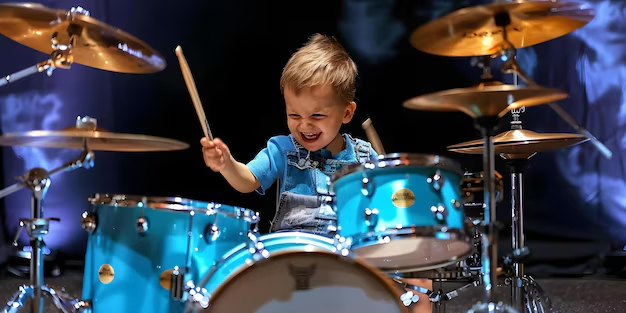
Welcome to the exciting world of drumming!
Whether you’re a parent supporting your child’s new passion or a student ready to rock out, you’ve come to the right place. At Educify, we’re all about making learning fun and accessible, and that includes mastering the drums. Getting started can feel like a whirlwind of new information, but don’t worry, we’re here to break it down for you.
This guide is packed with drumming tips for beginners to help you start your journey on the right beat. We’ll cover everything from holding your sticks to building a practice routine, so you can feel confident and start making some noise. Remember, every great drummer started right where you are now, with a pair of sticks and a desire to play.
So, let’s dive into these tips and get you on the path to becoming the amazing drummer you’re meant to be.
1. Your Grip and Posture are Everything
Before you even think about hitting the drums, let’s talk about how you hold your sticks and how you sit. It might not seem like the most exciting part of drumming, but getting your grip and posture right from the start will save you from bad habits and potential injuries down the road. It’s one of the most crucial drumming tips for beginners.
There are a few ways to hold your sticks, but the most common for beginners is the matched grip. This is where you hold both sticks the same way, like you’re shaking hands with them. Your thumb and index finger should do most of the work, creating a pivot point for the stick to bounce. Your other fingers will naturally wrap around the stick for support. Keep your grip relaxed; a tight grip will tire you out and restrict the stick’s natural rebound.
Now for your posture. Sit up straight with your feet flat on the floor. Your drum throne (that’s the stool you sit on) should be at a height where your thighs are slightly angled downwards. This will give you the best balance and power. Keep your shoulders relaxed and avoid hunching over.
Good posture isn’t just about looking the part; it’s about making your drumming more efficient and comfortable, which is essential for long practice sessions. This is a fundamental aspect of how to practice drums effectively.
2. Start with a Practice Pad
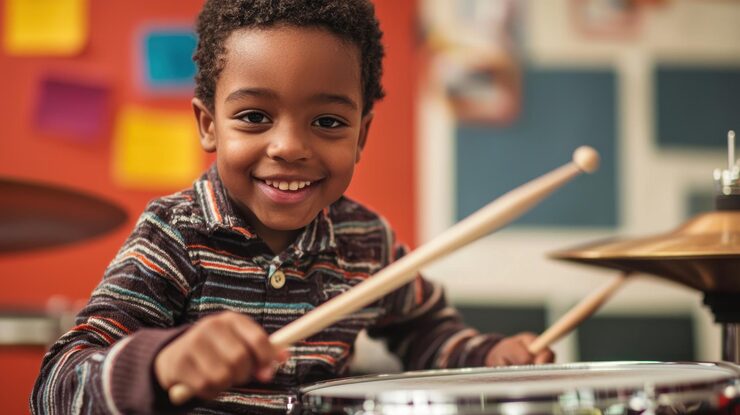
You don’t need a full drum set to start learning. In fact, one of the best drumming tips for beginners is to begin with a practice pad. A practice pad is a small, quiet pad that mimics the feel of a real drum. It’s a fantastic tool for developing your stick control, learning rudiments, and building muscle memory without driving your family or neighbors crazy.
This is a great answer to the question of how to practice drums without a drum set. You can work on your single strokes, double strokes, and paradiddles (more on those later) and really focus on the evenness and consistency of your hits. A practice pad is also super portable, so you can practice anywhere, anytime.
Many professional drummers still use practice pads to warm up and keep their hands in shape. It’s a testament to how valuable this simple tool is. So, before you invest in a full kit, get a practice pad and a pair of sticks. This is the perfect way to start your drum practice for beginners and build a solid foundation.
3. Get to Know Your Rudiments
Drum rudiments are the fundamental building blocks of drumming. They are a set of patterns that form the basis for more complex beats and fills. Think of them as the scales and arpeggios for drummers.
There are 40 official drum rudiments, but you don’t need to learn them all at once. Start with the basics: the single stroke roll, the double stroke roll, and the single paradiddle. The single stroke roll is simply alternating hits with your right and left hands (RLRL). The double stroke roll is two hits with each hand (RRLL). The single paradiddle is a combination of single and double strokes (RLRR LRLL).
Mastering these three drum rudiments will give you a solid foundation to build upon. They will improve your coordination, speed, and control. This is a core part of how to practice drums. You can practice them on your practice pad, and as you get more comfortable, you can start applying them to the drum set. Don’t underestimate the power of rudiments; they are the secret weapon of every great drummer.
Read more on drum rudiments here

4. The Metronome is Your Best Friend
Here’s one of the most important drumming tips for beginners: learn to love the metronome. A metronome is a device that produces a steady click at a set tempo. It might seem annoying at first, but playing with a metronome is the best way to develop a strong sense of time. As a drummer, your primary job is to keep the beat, and a metronome will train you to do just that.
Start by setting the metronome to a slow tempo and practice your rudiments and basic beats along with the click. Focus on making your hits line up perfectly with the click. As you get more comfortable, you can gradually increase the tempo. Playing with a metronome will also help you track your progress. You’ll be able to see how your speed and accuracy are improving over time.
This is a key element of drum practice for beginners. You can find metronome apps for your phone, so you don’t even need to buy a separate device. Make the metronome a regular part of your practice routine, and you’ll be a rock-solid timekeeper in no time.
Do you need an expert tutor to guide you through drumming? That’s what we do.
5. Practice Limb Independence
Drumming is all about coordination. You need to be able to move your hands and feet independently of each other. This can be a real challenge for beginners, but with practice, you can develop amazing limb independence. A great way to start is by breaking things down. Practice a simple pattern with just your hands, then add in your bass drum foot, and finally, your hi-hat foot.
For example, you can play a simple rock beat. Your right hand plays steady eighth notes on the hi-hat, your left hand hits the snare on beats 2 and 4, and your right foot plays the bass drum on beats 1 and 3. Start slowly and focus on keeping each limb in its own lane. This is a crucial aspect of how to practice drums.
There are also many exercises specifically designed to improve limb independence. You can find plenty of these on our blog or in drum instruction books. The more you work on it, the more natural it will become. And once you have good limb independence, a whole new world of drumming possibilities will open up to you.

6. Listen, Listen, Listen
One of the best ways to learn and get inspired is by listening to other drummers. Pay attention to the drummers in your favorite songs. What are they playing? How are they playing it? Try to identify the different parts of the drum set they are using. Are they playing a simple beat or something more complex? Can you tap along to the beat?
Listening to a wide variety of music will expose you to different drumming styles and techniques. This is an excellent addition to your drumming tips for beginners. Don’t just listen to rock music. Check out jazz, funk, Latin, and any other genre you can find. You’ll be amazed at the different ways drummers approach the instrument.
You can also watch videos of drummers playing online. This can be a great way to see how they use their hands and feet to create different sounds. So, put on your headphones and start listening. The more you listen, the more you’ll learn, and the more ideas you’ll have for your own drumming.
7. How to Practice Drums Without a Kit
So, you’re eager to learn, but you don’t have a drum set yet. No problem! There are plenty of ways to practice drumming without a full kit. As we mentioned earlier, a practice pad is a fantastic tool. But you can get even more creative.
One of the best drumming tips for beginners is to use pillows or cushions as your “drums.” They won’t make much noise, but they’ll give you a surface to practice your strokes on. You can also tap your hands on your lap or a tabletop. This is a great way to work on your rhythms and coordination when you’re away from your practice pad.
Another great tip on how to practice drums without a drum set is to practice your footwork. You can tap your feet on the floor to simulate the bass drum and hi-hat pedals. This will help you develop the muscles in your legs and improve your foot coordination. So, even if you don’t have a drum kit, you can still make a lot of progress.
It’s all about being creative and finding ways to practice the fundamental movements. This is a great way to get started with drum practice for beginners.
Do you need an expert tutor to guide you through drumming? That’s what we do.

8. Take it Slow and Be Patient
When you’re first starting out, it’s tempting to want to play fast and flashy beats right away. But one of the most important drumming tips for beginners is to take it slow and be patient. It’s much better to play a simple beat perfectly in time than to play a complex beat sloppily.
When you’re learning a new beat or rudiment, start at a very slow tempo. This will give you time to think about what you’re doing and focus on your technique. Once you can play it perfectly at a slow tempo, you can gradually increase the speed. This is a fundamental principle of how to practice drums.
Remember, drumming is a journey, not a race. It takes time and dedication to become a proficient drummer. So, don’t get discouraged if you’re not a rock star overnight. Celebrate your small victories and enjoy the process of learning. The more patient you are with yourself, the more progress you’ll make in the long run.
9. Record Yourself
This might sound a little intimidating at first, but recording yourself playing is an incredibly valuable practice tool. It’s one of those drumming tips for beginners that can really accelerate your learning.
You don’t need any fancy equipment; you can just use the voice recorder or video camera on your phone. When you listen back to your recordings, you’ll be able to hear your playing from a different perspective. You might notice timing issues that you weren’t aware of while you were playing. Or you might realize that your snare hits are not as consistent as you thought. It’s also a great way to track your progress.
Record yourself playing a beat or rudiment, and then record yourself playing the same thing a few weeks later. You’ll be amazed at how much you’ve improved. This is an excellent way to stay motivated and see the results of your hard work. So, don’t be shy. Start recording yourself, and use it as a tool to become a better drummer.
10. Have Fun!
Last but not least, remember to have fun! Drumming should be an enjoyable and rewarding experience. Don’t get so caught up in the technical aspects of playing that you forget to enjoy the music. Play along to your favorite songs. Experiment with different sounds and rhythms. Jam with other musicians if you have the opportunity.
The more fun you have, the more motivated you’ll be to practice. This is perhaps the most important of all the drumming tips for beginners. Don’t be afraid to make mistakes. Everyone makes them, especially when they’re learning something new. The important thing is to learn from your mistakes and keep playing.
So, let loose, make some noise, and enjoy the incredible journey of becoming a drummer. This is the heart of drum practice for beginners and what will keep you coming back to the kit day after day.
Conclusion
So there you have it, ten easy drumming tips for beginners to get you started on your musical journey. From mastering your grip and posture to having fun and playing along to your favorite songs, these tips will help you build a solid foundation and become the drummer you’ve always wanted to be.
Remember to be patient with yourself and celebrate your progress along the way. Drumming is a skill that takes time and dedication to develop, but with consistent practice and a positive attitude, you’ll be amazed at what you can achieve. So, keep these tips in mind, and most importantly, keep drumming!
Ready to take your drumming to the next level? Learn with us at Educify and get personalized lessons from the best tutors.













One Response