

Introduction
If you’ve ever felt that your French vocabulary is growing but your pronunciation still sounds “off,” you’re not alone. For most learners, the real issue is not grammar or word choice. It’s French vowels. French vowels shape how words sound, how sentences flow, and how easily native speakers understand you. Even small differences in vowel pronunciation can change meaning or make your speech harder to follow.
Unlike English, French vowel sounds are clean, stable, and tightly controlled. They do not slide or stretch. That difference alone explains why many learners struggle with accent and listening comprehension. Starting with French vowels gives you a strong foundation because vowels sit at the heart of every word you speak and hear. Once you understand how French vowels work, everything else in the language begins to sound clearer, more natural, and more confident.
What Are the French Vowels?
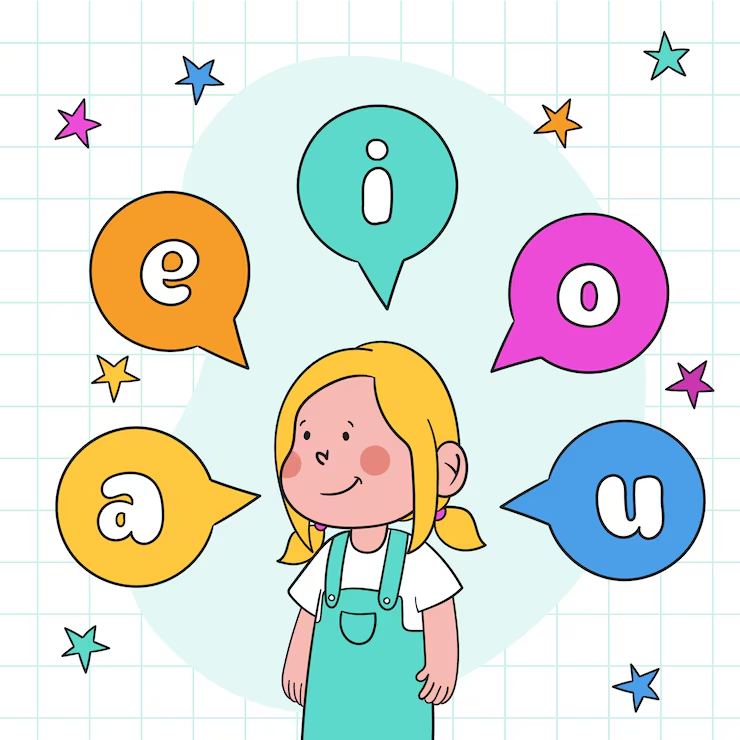
When learners ask what are the French vowels, the simplest answer is that French uses five vowel letters: a, e, i, o, u. You may also see y, which behaves like a vowel in certain words. At first glance, this looks familiar to English speakers. The confusion begins when you realize that French vowels are not just letters on a page. They are distinct sounds, and there are more vowel sounds than vowel letters.
In French, a vowel letter is what you see written. A vowel sound is what you actually pronounce. One letter can produce multiple sounds depending on spelling, accents, and position in a word. This is why French vowel sounds feel tricky at first. English often changes vowel sounds by sliding from one sound to another. French does not. Each vowel sound is clean, stable, and deliberate.
Here is a simple way to understand the system:
French vowel letters
- a
- e
- i
- o
- u
- y
French vowel sounds
French has about 15 core vowel sounds, depending on how linguists count them. These include:
- Oral vowels, produced only through the mouth
- Nasal vowels, produced through the mouth and nose
- Rounded vowels, where lip shape plays a major role
Below is a simplified overview to help you visualize the difference between letters and sounds:
| Vowel letter | Possible sounds | Example |
|---|---|---|
| a | /a/, /ɑ/ | ami, pâte |
| e | /e/, /ɛ/, /ə/ | été, mère, le |
| i | /i/ | ici |
| o | /o/, /ɔ/ | eau, porte |
| u | /y/ | tu |
| ou | /u/ | vous |
This distinction is essential if you want to truly understand French vowels. Learning the letters alone is not enough. Learning how the sounds are formed is what allows you to hear French clearly and pronounce it with confidence. This is the foundation for anyone who wants to truly learn French vowels the right way.
Read Also: The Best Way to Learn French: A Complete Beginner-Friendly Guide
Oral Vowels in French: The Foundation Sounds
Oral vowels are the backbone of French pronunciation. When you pronounce an oral vowel, all the air flows out through your mouth, not your nose. If your nose vibrates, you are no longer producing an oral vowel. This may sound technical, but in practice, oral French vowels are about mouth shape, tongue position, and lip control.

Most French vowel sounds fall into this category, and mastering them will immediately improve how natural your French sounds.
The /a/ and /ɑ/ sounds
These two sounds are often confusing because many modern speakers pronounce them similarly, but they are traditionally distinct.
- /a/ is a front, open vowel. Your mouth is open, and your tongue is slightly forward.
Example words: ami (friend), chat (cat) - /ɑ/ is deeper and slightly further back in the mouth.
Example words: pâte (paste), âme (soul)
Many learners merge these two sounds, and that is acceptable in modern spoken French. Still, hearing the distinction helps with listening comprehension.
The /e/ and /ɛ/ contrast
This contrast appears constantly in French.
- /e/ is a close sound, with the tongue raised.
Example words: été (summer), parler (to speak) - /ɛ/ is more open and relaxed.
Example words: mère (mother), crème (cream)
English speakers often slide these sounds or turn them into diphthongs. French vowel sounds stay steady from start to finish.
Core single oral vowels
Some oral vowels are more straightforward but still require precision.
- /i/ as in ici (here): lips relaxed, tongue high and forward
- /o/ as in eau (water): lips rounded, sound kept short
- /ɔ/ as in porte (door): more open than /o/
- /u/ as in vous (you plural): tightly rounded lips, tongue back
A key rule when learning French vowels is this: what your lips do matters just as much as what your tongue does. French relies heavily on lip rounding, far more than English.
Do not try to memorize these sounds mechanically. Instead, listen carefully, repeat slowly, and imitate native speakers. This approach builds muscle memory and helps French vowel sounds settle naturally into your speech.
Read Also: Why Learning French Is a Career and Life Advantage in a Global World
Nasal Vowels: The Sounds That Surprise Learners
Nasal vowels are often the moment learners realize French really does sound different. If oral vowels send air only through the mouth, nasal vowels send air through both the mouth and the nose at the same time. That nasal resonance is not accidental. It is a core feature of French vowels, and once you learn to hear it, you will notice it everywhere.

At first, nasal vowels feel strange because English does not truly have them. Learners often try to pronounce the final n or m, but in French, that consonant usually disappears and transforms the vowel instead.
The four main nasal vowel sounds
French has four commonly taught nasal vowel sounds. You do not need to master them all at once, but understanding how they work makes pronunciation far less mysterious.
- /ɑ̃/
This is a deep, open nasal sound.
Common spellings: an, am, en, em
Examples: sans (without), champ (field) - /ɛ̃/
This is a lighter nasal sound, higher in the mouth.
Common spellings: in, im, ain, ein
Examples: fin (end), pain (bread) - /ɔ̃/
This nasal sound is rounded and produced further back.
Common spellings: on, om
Examples: bon (good), nom (name) - /œ̃/
This is the least frequent and often the hardest to hear.
Common spellings: un, um
Examples: un (one), parfum (perfume)
Spelling patterns learners should watch for
A nasal vowel usually appears when a vowel is followed by n or m, and that n or m is not followed by another vowel.
Compare:
- bon → nasal vowel
- bonne → oral vowel plus pronounced n
This rule alone helps learners instantly improve clarity.
Common mistakes to avoid
- Pronouncing the final n or m
- Over-nasalizing until the sound becomes exaggerated
- Blocking airflow instead of letting it resonate naturally
When you learn French vowels, nasal sounds feel odd at first, but they are not difficult. Relax your mouth, let the sound flow, and trust your ear. Once nasal vowels click, listening comprehension improves dramatically because many everyday words depend on them.
The Tricky French “U” vs “OU” Sound
This contrast alone explains why many learners feel their accent sounds “off,” even when their vocabulary is strong. The French /y/ and /u/ sounds are both common, but to English ears, they can sound almost identical. Mastering this difference is a major milestone when working on French vowels.
Why this pair causes so much trouble
English does not have the /y/ sound at all. So learners naturally replace it with /u/, even though French treats them as completely different vowel sounds that can change meaning.
Compare:
- tu (you) → /y/
- tout (everything) → /u/
Say them incorrectly, and a native speaker will still understand you, but your speech will immediately sound foreign.
How to pronounce /u/ (“ou”)
This sound is familiar. It is similar to the “oo” in food, but shorter and cleaner.
- Lips: rounded
- Tongue: pulled slightly back
- Airflow: steady, through the mouth
Examples: vous, sous, fou
How to pronounce /y/ (“u”)
This is where technique matters. Start by saying /i/, like the vowel in machine. Keep your tongue exactly there. Now, without moving the tongue, round your lips tightly.
That new sound is /y/.
- Tongue: forward and high
- Lips: strongly rounded
- Airflow: controlled and focused
Examples: tu, lune, su
Listening tips that actually help
- Exaggerate the lip rounding when practicing alone
- Alternate minimal pairs: tu / tout, lune / loune
- Watch native speakers and notice lip shape, not just sound
This distinction is one reason French vowel sounds reward careful listening over memorization. Train your mouth as much as your ear, and the difference becomes automatic.

Silent Letters and Their Impact on French Vowels
One of the most confusing parts of French vowels for learners is this simple truth: French spelling shows history more than sound. Many letters you see are not meant to be pronounced, yet they strongly influence how vowels behave.
Why French has so many silent letters
French evolved from Latin, and over time, consonant sounds at the ends of words faded out. The spelling stayed, but the pronunciation changed. That is why words like parler, petit, and grand end with consonants you usually do not say.
This matters because vowel sounds in French are often shaped by what follows them, even when that letter stays silent.
How silent letters affect vowel pronunciation
Consider these pairs:
- petit → the final t is silent, but the i stays clear and clean
- petite → the final e is pronounced, changing the rhythm and flow
- beau → silent u, but it signals the /o/ sound
Silent letters often tell you whether a vowel is open or closed, especially with e, which can sound very different depending on the spelling.
Liaison and vowel flow
French does not like abrupt stops. When a word ending in a silent consonant is followed by a vowel, that consonant may reappear through liaison:
- les amis → the s links to the next word
- un enfant → the n connects smoothly
This creates a flowing rhythm where vowels connect across words, rather than standing alone.
To truly learn French vowels, you must hear them inside phrases, not just isolated words. French pronunciation lives in flow, not fragments.
Read Also: 100 Basic French Words You’ll Actually Use in Real Conversations
Accents and Diacritics: How They Change Vowel Sounds
In French, accents aren’t just decoration—they’re essential for pronouncing French vowels correctly and understanding meaning. Ignoring them can turn one word into another entirely, so paying attention is crucial for learners.
The main French accents
- Accent aigu (é) – Only on e, as in école. It signals a close-mid /e/ sound, like the “ay” in English “play,” but without a diphthong.
- Accent grave (è, à, ù) – Changes pronunciation, especially è, which is open-mid /ɛ/, like crème.
- Accent circonflexe (ê, â, î, ô, û) – Often indicates historical letters that disappeared. For vowels, it can open the vowel slightly: hôtel → /o/ vs /ɔ/.
- Tréma (ë, ï, ü, ö, ÿ) – Shows that the vowel is pronounced separately from the previous one: Noël → /nɔ.ɛl/.
Why accents matter
- Clarify pronunciation: pêche (peach) vs pêche (fishing)
- Affect vowel sounds and mouth shape, essential for french vowel sounds
- Prevent misunderstandings in communication
Tips for learners
- Always pronounce accented vowels clearly; they are never silent.
- Notice how accents guide tongue position and lip rounding.
- Practice reading aloud, paying attention to differences between é, è, and ê.
Mastering accents is a shortcut to speaking naturally and confidently. Proper use of diacritics makes your French vowels sound accurate and fluent.

Common Mistakes English Speakers Make With French Vowels
English speakers often struggle with French vowels because we unconsciously apply English pronunciation rules. Recognizing these pitfalls is the first step to improving your accent and comprehension.
Typical mistakes
- Over-pronouncing vowels – Stretching sounds longer than needed, e.g., saying école like “ay-coal” instead of a clean /e/.
- Adding diphthongs where none exist – Turning single French vowel sounds into a glide, like pronouncing peu as “pay-oo” instead of /pø/.
- Ignoring mouth shape and lip rounding – French requires precise tongue placement and rounded or unrounded lips; neglecting this distorts vowel sounds.
- Treating French vowels like English vowels – Substituting English vowel sounds leads to confusion, e.g., pronouncing ou as “oo” in English “book” instead of /u/.
How to overcome these mistakes
- Listen actively to native speakers and imitate exact sounds.
- Practice French vowel sounds in isolation before using them in words.
- Use minimal pairs (words that differ by only one vowel) to train your ear.
Focusing on these common errors will dramatically improve your pronunciation and help you learn French vowels more accurately.
How Mastering French Vowels Improves Your Overall French
Getting a solid grip on French vowels can transform your entire learning experience. When you pronounce vowels correctly, your accent becomes more authentic, making you easier for native speakers to understand.
Listening comprehension also improves: you start distinguishing subtle differences between words like beau and bot, which might otherwise sound identical to English ears. Confidence naturally follows—once your vowels sound right, you’ll feel more comfortable speaking in conversations or reading aloud.
Beyond pronunciation, mastering vowels helps with French rhythm and flow, because vowels shape syllables and sentence melody. It also supports structured learning: practicing vowel sounds systematically sets a strong foundation for tackling grammar, conjugation, and more complex vocabulary.
In short, learning to control French vowel sounds isn’t just a small detail, it’s a key step in becoming a fluent, confident French speaker.
Final Thoughts
French vowel sounds may seem tricky at first, but they follow logical patterns you can master with steady practice. Focus on listening, imitating, and repeating, and you’ll notice your pronunciation improving naturally. Patience and consistency are your best allies. Don’t rush; even small daily exercises can make a big difference over time. The key is to integrate French vowels into your learning routine rather than treating them as isolated sounds.
Ready to level up your French? 📚
Join Educify and learn French vowels with expert tutors through structured lessons designed to make your pronunciation clear, confident, and delightfully French!