
Learning the piano is one of the most rewarding skills you can pick up, whether you are six years old or sixty. Many people assume that you need expensive lessons, a private tutor, or years of formal music school to begin. The truth is that you can learn piano yourself with the right approach, the right structure, and the right mindset.
In fact, many self taught pianists have become excellent players simply by following a disciplined, enjoyable, and well organized learning path. If you have ever wondered how to learn piano yourself in a way that feels natural and doable, this guide will give you everything you need.
This is not a shallow guide. You will learn how to break down piano concepts into understandable pieces, how to practise effectively, how to build confidence with every session, and how to avoid the common mistakes new players make. The goal is simple. By the end of this guide, you will know exactly what to learn first, how to structure your sessions, how to build long term fluency, and how to enjoy the learning journey from day one.
What Is the First Thing to Learn on the Piano?
When people start researching how to learn piano yourself, one of the first questions they ask is what they should learn first. The very first step is understanding the layout of the piano. Think of the keyboard as a map. Before you can travel, you must know where everything is.
1. Learn the Pattern of Black and White Keys
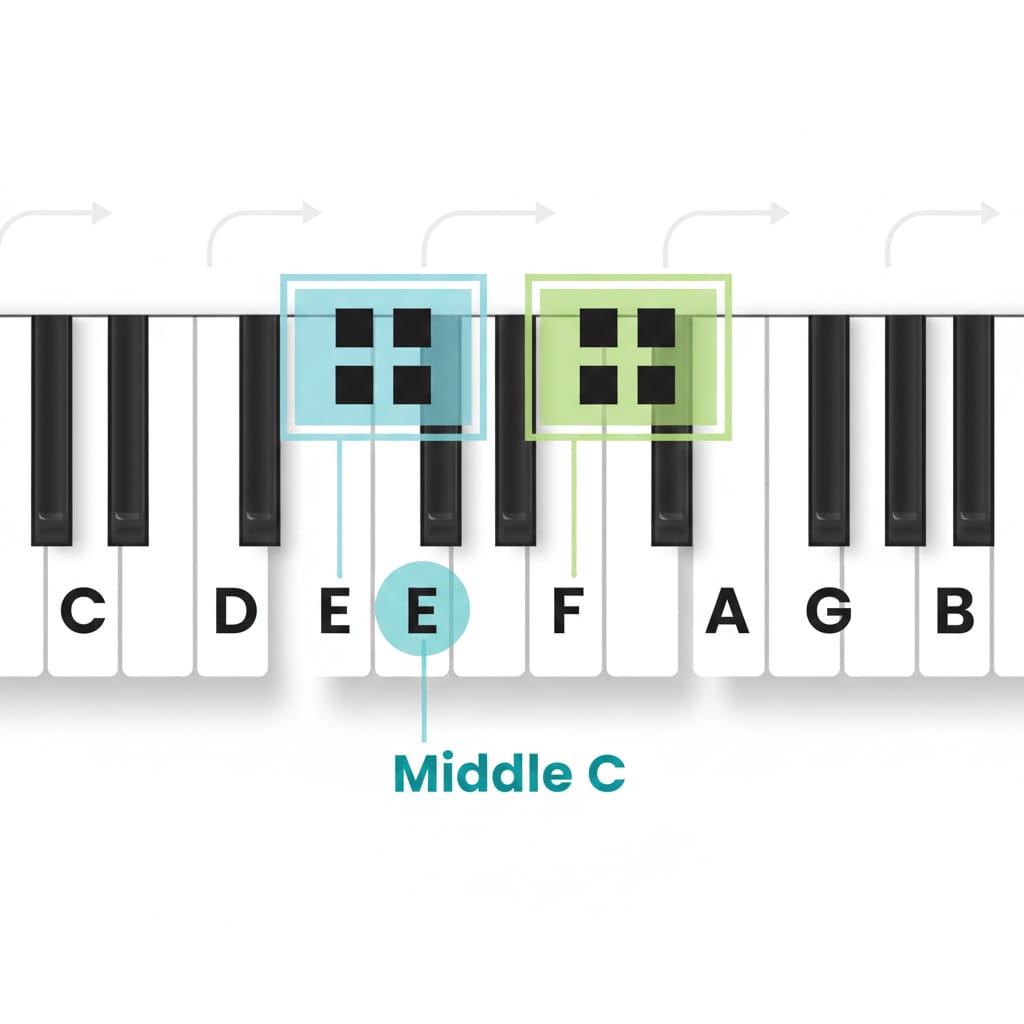
Every piano follows a repeating pattern. You will notice groups of two black keys and groups of three black keys. These groups repeat across the entire keyboard. By identifying these two patterns, you can immediately locate any note. For example:
- The white key to the left of a group of two black keys is C.
- The white key between the first and second black key in the group of three is A.
This simple pattern helps you instantly learn the geography of the keyboard, and it forms the foundation of learning how to learn piano yourself effectively.
2. Learn Finger Numbers
Piano teachers worldwide use the same numbering system for fingers:
- Thumb is 1
- Index is 2
- Middle is 3
- Ring is 4
- Pinky is 5
Why learn this first? Because almost every beginner piece and exercise will label finger numbers, making it easier for you to position your hands correctly.
3. Learn Basic Hand Position
A comfortable hand position is critical. Many beginners tense their fingers, which slows progress. A relaxed curved shape, almost like holding a bubble, helps you control sound better and prevents injury.
4. Learn Middle C Position
Middle C is often the starting point for beginners because it gives a central reference. When you know where Middle C is, you can navigate outward confidently.
A helpful resource for understanding how learning works in general is this guide on How Your Brain Learns. It explains how your brain absorbs and retains new skills and can complement your piano journey.
What Is the 80/20 Rule in Piano?
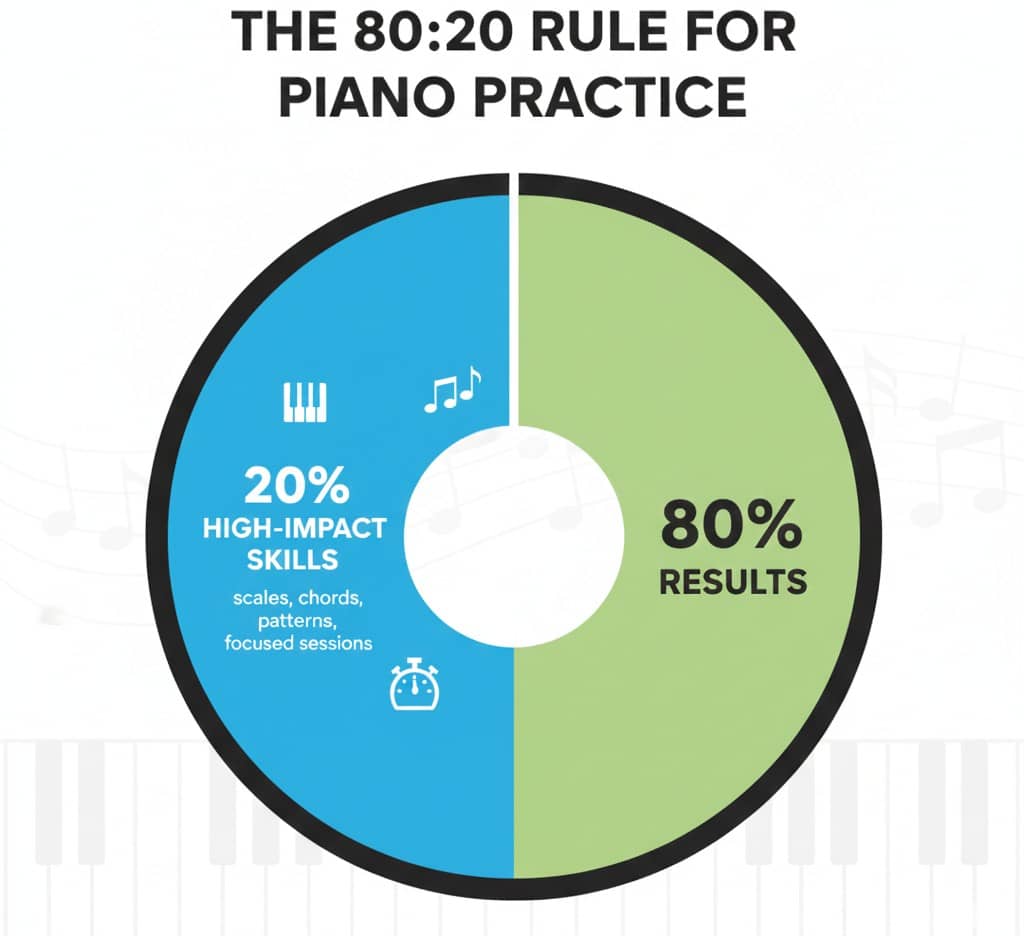
The 80/20 rule is one of the most powerful ideas for anyone trying to understand how to learn piano yourself without feeling overwhelmed. The principle comes from the Pareto concept, which states that 20 percent of your actions lead to 80 percent of your results. When applied to music, this rule helps you focus on the activities that genuinely move your skills forward instead of wasting time on things that do not create growth.
The beauty of the 80/20 rule is that it simplifies learning. Instead of practising everything at once, you identify the small number of techniques, exercises, and habits that give you the biggest improvement. This approach is helpful for beginners because piano can feel complicated at first. By narrowing your focus, you build skills faster, make fewer mistakes, and stay motivated because progress feels visible.
Here is what the most important 20 percent usually looks like for piano learners.
1. Practise High Frequency Patterns
Music is built on patterns, and these patterns repeat across songs, genres, and levels. Chords, scales, chord progressions, left hand shapes, and rhythmic motifs appear again and again. When you practise these high frequency elements, you create a foundation that applies to almost everything you play. This is especially helpful if you are figuring out how to learn piano yourself, because mastering a handful of patterns speeds up your ability to learn new pieces.
For example, the I–V–vi–IV chord progression appears in hundreds of pop songs. The simple C major scale shows up in classical, gospel, and contemporary music. Learning a few broken chord patterns helps your left hand accompany melodies more fluidly. Because these patterns repeat so often, time spent mastering them gives you huge results with minimal effort.
2. Focus on Consistency Over Length
Many learners believe they must practise for an hour a day to improve. In reality, the brain learns best through short, focused, consistent sessions. Ten minutes of intentional practice can produce better results than sixty minutes of distracted, unfocused playing. This is a core principle of the 80/20 rule and a valuable insight if you are exploring how to learn piano yourself at home.
Consistency helps your fingers build muscle memory and keeps the learning process enjoyable. Long practice sessions can sometimes cause frustration or fatigue. Short sessions feel lighter, easier to maintain, and far more effective. The best pianists in the world often break their practice into small blocks because the brain benefits from repetition rather than long stretches of pressure.
3. Prioritize Songs That Teach Multiple Skills
A smart way to use the 80/20 rule is by choosing songs that develop several skills at once. A well chosen song can improve your rhythm, finger strength, hand coordination, expression, reading ability, and familiarity with musical patterns. Instead of working on ten separate drills, you learn all those skills inside a single piece.
For example, a simple classical piece may teach phrasing and dynamics, while a pop song may develop left hand patterns and timing. When you select songs that stretch you in more than one area, your progress multiplies. This is a practical strategy for anyone following how to learn piano yourself, because it prevents boredom and gives you a tangible way to measure your improvement from week to week.
4. Remove Distractions and Stay Present
The science of learning consistently shows that your brain absorbs information faster when your environment supports deep focus. A quiet space, a comfortable chair, and a distraction free setup allow you to stay mentally present. Even a two minute break to check your phone can disrupt your concentration and make it harder to build muscle memory.
If you want to understand how learning works at a deeper level, you can explore more insights here:
https://learn.educify.org/science-of-learning/
A focused mind is far more effective than a busy one. When you stay present, you understand rhythms better, coordinate your hands more easily, and hear mistakes more clearly. This is one of the simplest yet most powerful ways to strengthen how to learn piano yourself with fewer frustrations along the way.
What Are the 7 Basic Music Notes on the Piano?
If you want to understand how to learn piano yourself, you must know the basic building blocks of music. The piano uses seven natural notes that repeat in higher or lower pitches. These notes are:
- A
- B
- C
- D
- E
- F
- G
When you reach G, the sequence repeats as A again. On the piano, these notes appear across several octaves. Each octave sounds higher or lower, but the notes remain the same.
Why These Notes Matter
These seven notes form:
- Every scale
- Every chord
- Every melody
- Every song
- Every pattern you will learn
For example, the C major scale uses the notes C, D, E, F, G, A, and B. This scale is like the alphabet of music. Once you know it, reading and playing music becomes easier and more intuitive.
A helpful tip when learning these notes is to connect them to songs. For instance:
- The note C sounds like the first note of “Twinkle Twinkle Little Star”.
- The note G is often used in melodies for its bright sound.
The more you connect notes to sounds, the faster your ear develops, which is key in understanding how to learn piano yourself effectively.
If you enjoy seeing how other subjects break down learning, this guide on active learning can show you how to practise in a way that sticks.
What Are the 8 Levels of Piano?
As you continue exploring how to learn piano yourself, understanding the eight common levels of piano progression helps you track your growth in a structured way. These levels appear in most music schools and international examination boards. Even if you are learning at home, they give you a clear sense of your current stage and what skills come next.
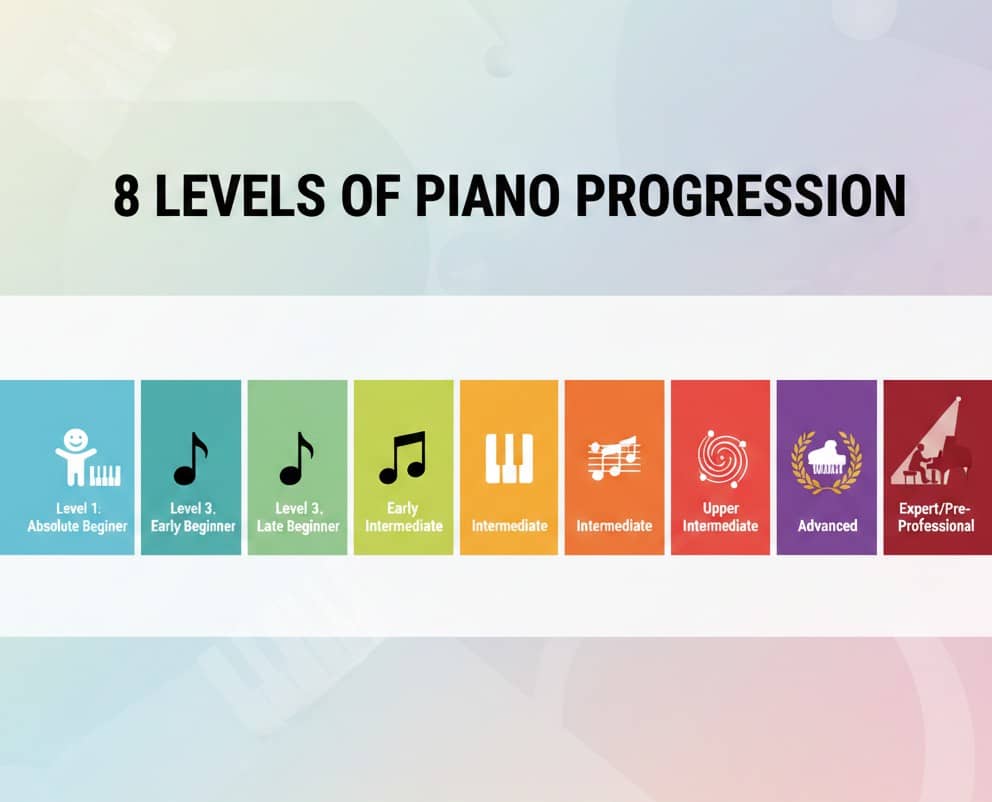
Level 1: Absolute Beginner
At this stage, everything is brand new. You learn the layout of the keyboard, hand position, finger numbers, and the names of basic notes. You start reading simple rhythms such as quarter notes and half notes. Most learners at this stage focus on one hand at a time, usually the right hand. If you are focusing on how to learn piano yourself, this level is about building confidence and familiarity rather than playing songs perfectly.
Level 2: Early Beginner
Now you start putting both hands together for the first time. You play simple melodies in the right hand while adding very basic left hand notes or chords. You also practice simple patterns like playing C major chords or moving between two easy chords. This level introduces very simple songs that build coordination, an important part of how to learn piano yourself without getting overwhelmed.
Level 3: Late Beginner
Here you learn slightly more complex rhythms such as dotted notes and syncopation. You also begin learning your first scales, usually C major, G major, and F major. Your left hand becomes more active with basic patterns like broken chords and simple accompaniment styles. This is usually the level where songs start sounding more musical and expressive, which keeps motivation strong if you are mastering how to learn piano yourself at home.
Level 4: Early Intermediate
At this stage, you can play longer pieces with both hands smoothly. You start working on dynamics such as soft and loud playing, plus articulation like staccato and legato. You also learn to control finger strength so every note sounds balanced. Music theory becomes more important here, especially if you want to understand chords while exploring how to learn piano yourself at a more advanced level.
Level 5: Intermediate
You expand your technical skills by learning more scales, arpeggios, and chords. You also play songs with faster rhythms and more complex hand coordination. You develop expressive playing skills, which help your music feel natural and emotional. This is the level where you start sounding less like a beginner. Many learners who focus on how to learn piano yourself find this level exciting because songs become richer and more rewarding.
Level 6: Upper Intermediate
This level opens the door to classical pieces by composers like Bach, Beethoven, and Mozart. You also learn pop arrangements that require wide hand stretches, finger independence, and more advanced patterns. You develop strong technique, which makes playing feel smoother and more controlled. If you are still following how to learn piano yourself, this level teaches you how to practice smarter rather than harder.
Level 7: Advanced
You now play pieces that demand precision, speed, and emotional interpretation. Complex rhythms, fast passages, and extended sections become manageable. You also learn to read music quickly and understand musical phrasing with depth. At this stage, you feel like a confident pianist with a personal style. Many learners reaching this point after focusing on how to learn piano yourself feel a strong sense of accomplishment.
Level 8: Expert or Pre Professional
This is the highest level before entering professional training. You can sight read fluently, interpret music independently, and play difficult concert level pieces. Your technique is refined, your expression is mature, and you understand advanced theory. Although few self learners reach this stage without guidance, it is completely possible if you stay consistent with how to learn piano yourself and follow a structured path.
A great resource for developing study habits along the way is this article on studying smarter: The Best Study Techniques for Students to study Smarter Not Harder.
Can You Learn Piano in 3 Months?
A common question among beginners is whether they can learn piano in three months. The simple answer is yes, you can learn a surprising amount in that time if you follow a focused plan. Here is what three months of dedicated learning can realistically give you:
Month 1: Foundation
- Learn note names
- Understand hand position
- Play simple one hand melodies
- Learn basic rhythms
- Start simple left hand chords
By the end of the first month, many learners can play simple songs confidently.
Month 2: Coordination
- Learn to combine both hands
- Build finger strength
- Practise scales and patterns
- Play beginner friendly pop songs
- Improve timing through metronome work
This month is where most learners begin to feel like proper pianists.
Month 3: Application
- Learn two handed beginner songs
- Play simple classical pieces
- Understand chord progressions
- Develop musical expression
- Strengthen consistency
By the end of three months, you will be able to play multiple songs, understand musical structure, and practise independently. This is the power of knowing how to learn piano yourself in a structured way.
How to Practise Piano Effectively When Learning by Yourself
One of the most important skills is practising with intention. Practice does not mean repeating something for an hour. It means working with focus and purpose.
- Break Songs into Sections: Do not play a full song from start to finish every time. Choose one small section, master it, then move on.
- Slow Down More Than You Think: Playing slowly builds accuracy. Accuracy builds speed naturally.
- Record Yourself: Listening back helps you identify mistakes you may not notice while playing.
- Use a Mix of Scales and Song: Scales build technique, songs build musicality. Both are important.
- Reward Progress: Learning the piano is a marathon. Celebrate small wins.
Common Mistakes When Learning Piano Yourself
Here are common mistakes beginners make and how to avoid them:
- Mistake 1: Playing Too Fast
Fix: Slow practice is the fastest way to progress.
- Mistake 2: Avoiding the Left Hand
Fix: Your left hand provides rhythm and structure. Practise it separately when needed.
- Mistake 3: Not Using Finger Numbers
Fix: Finger numbers create smoother playing and better hand control.
- Mistake 4: Never Reviewing Old Songs
Fix: Revisiting older songs builds confidence and strengthens memory.
- Mistake 5: Comparing Yourself to Others
Fix: Your journey is your own. Growth comes with time.
Conclusion
Learning piano yourself is fully possible with structure, curiosity, and consistent practice. When you understand what to learn first, how to apply the 80/20 rule, how to recognise the seven basic notes, and how to measure progress across levels, you can grow faster than you ever imagined. Your piano journey becomes enjoyable, exciting, and deeply rewarding. You do not need perfect talent. You only need to start.
Start Learning Piano With Us Today!
If you are ready to take your piano skills to the next level, Educify offers high quality learning resources, engaging subject courses, and practical lessons created to help you master new skills with confidence. Whether you are learning piano, languages, science, or school subjects, we are here to guide you every step of the way.
Start learning with Educify today and discover how far your abilities can grow.










3 Responses