
Introduction
Many people start learning drums with a picture in their head of fast fills, loud solos, and impressive speed. That expectation is understandable, but it skips over what actually makes a drummer sound good. For beginners, progress does not come from playing fast or copying complex patterns. It comes from understanding rhythm, control, and timing first.
When learning drums for beginners, the most important skills are often the least flashy. Keeping steady time, knowing when not to play, and learning how different parts of the drum kit work together matter more than how many notes you can hit. Drummers are the foundation of any band. If the timing is weak, everything else falls apart.
This article is designed to walk you through what really matters when starting out. You will learn how rhythm works, which skills to focus on early, how to practice even without a full drum kit, and how to avoid common mistakes that slow beginners down.
If you are serious about learning drums, setting realistic expectations from the start will save you frustration and help you improve faster. The goal is steady progress, not shortcuts.
Understanding Rhythm: The Foundation of Learning Drums
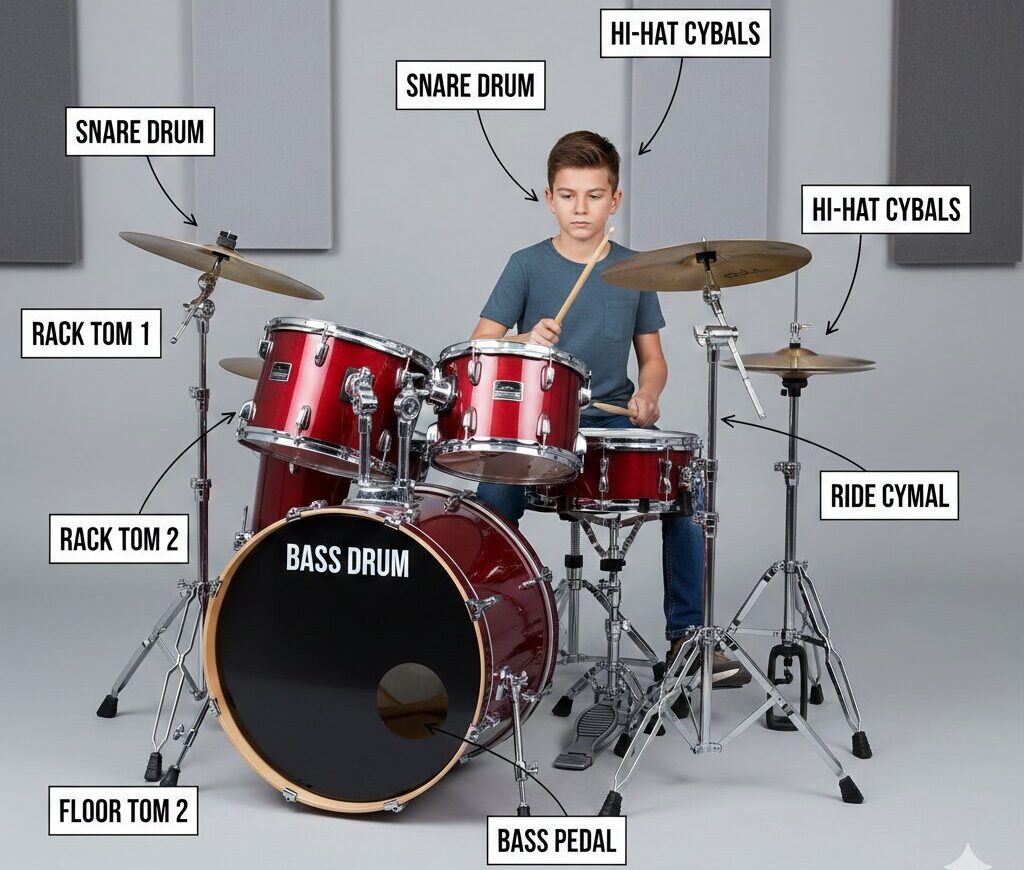
Rhythm is the core of learning drums, even before you touch a drumstick. At its simplest, rhythm is how music is organized in time. Most beginner drum patterns are built around counting to four. You count 1, 2, 3, 4 repeatedly while keeping the same spacing between each number. That steady spacing is what creates a groove.
When people talk about timing, they are talking about how accurately you stay within that count. For anyone focused on learning drums for beginners, this skill matters more than speed or complexity. A slow beat played in time always sounds better than a fast beat that rushes or drags. This is why drummers are often called the backbone of a band. Other musicians rely on the drummer to keep everything together.
Good rhythm also helps your body relax while playing. When beginners struggle with timing, they often tense up, which makes mistakes more common. Learning to feel the count instead of forcing it allows your hands and feet to move more naturally. This is a key step in long term improvement.
Many beginners make the same rhythm mistakes. They speed up without noticing, skip counting while playing, or focus too much on fills instead of the beat. These habits can slow progress if they are not corrected early. One of the most helpful voice lesson tips style ideas that also applies here is consistency. Practicing simple rhythms daily trains your internal clock.
By building a strong sense of rhythm early, learning drums becomes less confusing and more enjoyable. Everything else you learn later rests on this foundation.
How Bass and Snare Work Together
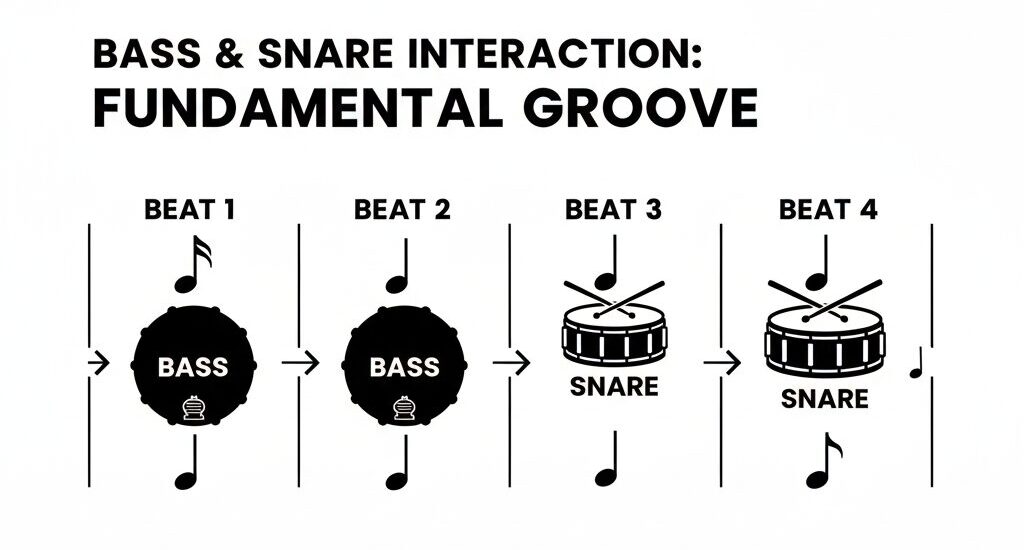
One of the most important concepts in learning drums is understanding how the bass drum and snare drum interact. These two pieces create the structure of most drum beats you hear in popular music. When beginners learn how they work together, many rhythms suddenly make sense.
The bass drum usually provides the low, grounding pulse. It often lines up with strong counts like 1 and 3. The snare drum adds contrast and clarity, commonly landing on counts 2 and 4. This back and forth creates a steady framework that listeners naturally respond to. For anyone focused on learning drums for beginners, mastering this relationship is more valuable than learning complex patterns.
A simple coordination exercise is to tap your foot for the bass drum while clapping your hands for the snare. Count out loud as you do this. This trains your brain to separate roles between your limbs, which is a major challenge early on. You do not need a full kit to practice this. Even silent practice builds coordination.
Many beginners struggle because they treat each drum as an isolated sound. In reality, the bass and snare work as a team. When one is weak or poorly timed, the entire groove suffers. This is why teachers spend so much time on basic beats during early learning drums sessions.
Once this interaction feels natural, adding hi-hats, fills, and variations becomes much easier. A solid bass and snare foundation turns simple beats into music that feels confident and controlled.
Learning to Play with 8th Notes
As you continue learning drums, 8th notes are one of the first rhythmic ideas that expand your playing. An 8th note simply divides each count into two equal parts. Instead of counting 1, 2, 3, 4, you count 1 and 2 and 3 and 4 and. This creates a smoother and more flowing rhythm.
For learning drums for beginners, 8th notes are most often played on the hi-hat. This steady pattern helps anchor your timing while the bass and snare handle the main accents. The key is control. Each hit should sound even, not rushed or uneven. Playing slower with accuracy builds better habits than pushing speed too early.
A helpful exercise is to play 8th notes softly on the hi-hat while keeping the bass drum on 1 and 3 and the snare on 2 and 4. Count out loud as you play. This trains your hands and feet to work together without tension. It also improves your internal sense of time.
Many beginners rush 8th notes because they feel repetitive. Staying patient here pays off. Strong 8th note control makes grooves feel steady and professional. As learning drums progresses, this skill supports nearly every style of music you will play.
Practicing Drum Beats With or Without a Drum Kit
One of the most useful tips for learning drums for beginners is realizing you do not always need a full drum kit to practice. Muscle memory and coordination can be developed anywhere, even on a pillow, practice pad, or table. Air-drumming exercises allow you to focus on rhythm, hand independence, and timing without worrying about volume or setup.
Silent practice is surprisingly effective. By mimicking beats and fills, your brain and body learn the motions required to play accurately. For beginners, this reduces mistakes when they move to a real kit. You can even practice drum rudiments like single strokes, double strokes, and paradiddles without a drum. Counting out loud while performing these motions strengthens rhythm awareness.
Daily practice, even in small chunks of 10–15 minutes, is better than occasional long sessions. Incorporating exercises that focus on the bass-snare interaction, hi-hat 8th notes, and simple fills prepares you for real drumming scenarios. Using a metronome while practicing—even silently—builds timing discipline that will be invaluable later.
By making practice accessible and consistent, learning drums becomes less intimidating. Beginners can develop strong fundamentals before ever sitting at a full kit. This approach helps prevent frustration and accelerates progress, keeping the learning process fun and effective.
Drum Equipment Beginners Actually Need
When learning drums for beginners, it’s easy to feel overwhelmed by all the equipment options. You do not need everything at once. Starting simple helps you focus on the basics without spending too much money. Here’s what beginners actually need:
1. Drum Kits
- Acoustic kits: Classic feel and sound; ideal if space and budget allow.
- Electronic kits: Quiet practice and built-in metronomes; perfect for apartments.
2. Essential Accessories
- Practice pads: Great for silent exercises and rudiments.
- Drumsticks: Choose a pair that feels comfortable in your hands.
- Throne (seat): A stable seat helps maintain posture and control.
3. Optional But Helpful
- Metronome: Keeps your timing consistent.
- Pedals: Bass drum pedals can be added gradually as you improve.
Beginners should avoid splurging on extras like multiple cymbals or fancy hardware at first. Focus on mastering rhythm, coordination, and basic beats before upgrading.
By using the right gear for your skill level, learning drums becomes more enjoyable and less frustrating. A small, manageable setup allows beginners to concentrate on building strong fundamentals rather than worrying about equipment.
Tip: Start with the essentials, then gradually expand your kit as your skills grow.
Experimenting With Drum Grip Styles
Once you understand the basics of holding sticks, it’s time to experiment with learning drums for beginners by finding what feels natural for you. Every drummer’s hands are different, and slight adjustments can improve comfort and control.
Tips for experimenting:
- Try small changes in finger placement to see which gives better rebound.
- Adjust your wrist angle for less tension and smoother motion.
- Test both matched and traditional grips to find which suits your style.
- Practice simple beats with each grip to compare feel and accuracy.
Teachers often guide beginners in refining grip styles gradually. Remember, your grip is not fixed; it evolves as your speed, power, and technique improve. Focus on comfort and control first. A grip that feels natural allows you to play longer without fatigue and supports all other aspects of learning drums.
Naming and Understanding Drum Kit Parts
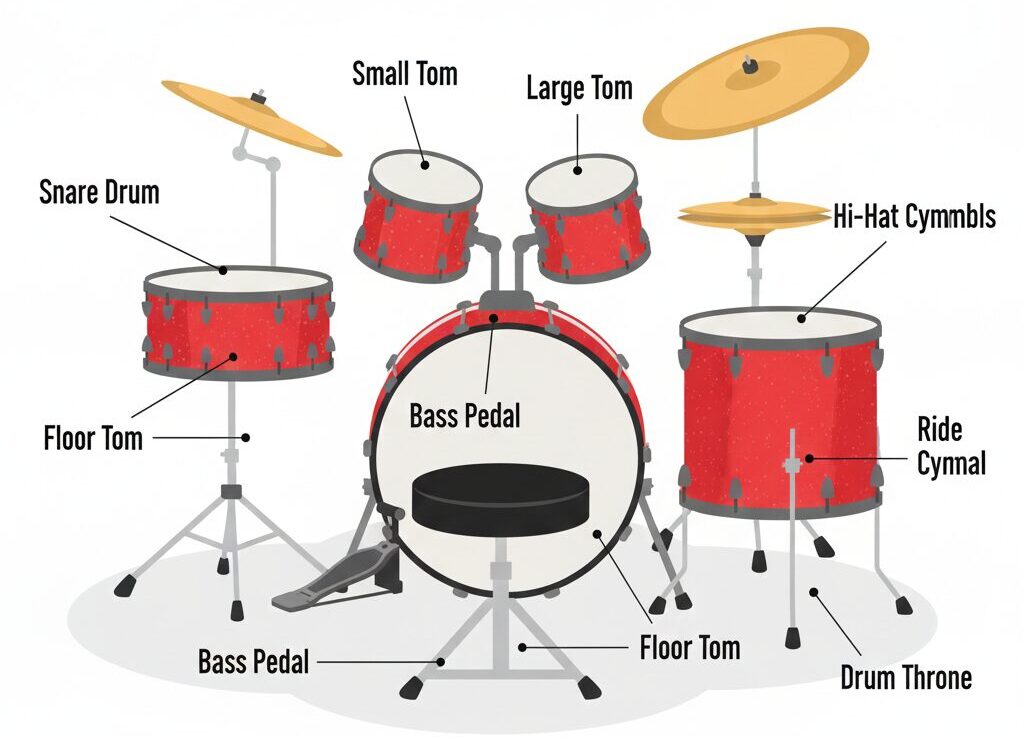
For beginners, knowing the parts of a drum kit is just as important as learning rhythms. Understanding each piece helps you follow lessons, read drum notation, and communicate effectively with instructors or bandmates. Here’s a clear breakdown:
1. Bass Drum
- The large drum played with a foot pedal.
- Provides the low-end “pulse” that drives most beats.
2. Snare Drum
- Positioned between your legs, produces a sharp, crisp sound.
- Accents beat 2 and 4 in common patterns.
3. Hi-Hat
- Two cymbals controlled by a foot pedal.
- Plays steady rhythms, often 8th notes, and creates dynamics.
4. Toms
- Smaller drums mounted above or beside the bass drum.
- Used for fills and adding variety to grooves.
5. Crash and Ride Cymbals
- Crash: Explosive accent, usually at the end of phrases.
- Ride: Maintains steady rhythms, often replacing the hi-hat in certain patterns.
Why Knowing Names Matters:
- When following lessons or sheet music, instructors will reference specific drums or cymbals.
- Clear terminology prevents confusion and speeds up learning drums.
- Recognizing parts helps when setting up your kit and troubleshooting sound issues.
Label your drum kit with small sticky notes if needed. Associating names with sounds accelerates both practice and comprehension. This foundational knowledge ensures you can focus on technique and rhythm instead of hunting for the right drum.
Reading Drum Sheet Music and Tabs
A key skill for learning drums for beginners is reading drum notation. Understanding sheet music or drum tabs allows you to learn new beats faster and play more complex rhythms accurately.
1. How Drum Notation Works
- Drum music is written on a five-line staff, similar to standard sheet music.
- Each line or space represents a different drum or cymbal.
- Symbols indicate which hand or foot to use and how long to hold the note.
2. Drum Tabs vs. Sheet Music
- Sheet music: More formal, precise, and used for advanced learning.
- Tabs: Simplified, using letters or symbols to show which drum to hit; great for beginners.
3. Approaching Reading as a Beginner
- Start slow: play notes one at a time to understand patterns.
- Clap rhythms before using the drum kit.
- Focus on common beats and rudiments before tackling fills.
4. Why Reading Supports Progress
- Allows you to learn songs without relying solely on videos or teachers.
- Helps in playing with other musicians, as you can follow charts in real time.
- Builds confidence and independence in your practice sessions.
Tip: Combine reading with playing. Read a measure, then play it slowly. Gradually increase speed as your accuracy improves. This method strengthens timing, coordination, and memory—all essential when learning drums.
Read Also:
- Best Coding Websites to Learn DSA in a Fun Way
- How to Play Guitar for Beginners: Practical Steps That Actually Works
- The Best Study Techniques for Students to Study Smarter, Not Harder
Essential Drum Rudiments for Beginners
Drum rudiments are the building blocks of drumming. When learning drums for beginners, mastering these basic patterns develops control, speed, and consistency. Rudiments may seem simple, but they are the foundation for more complex beats and fills.
1. What Drum Rudiments Are
- Short, repeatable patterns that teach hand technique and coordination.
- Practiced slowly at first, then sped up as control improves.
2. Key Beginner Rudiments
- Single Stroke Roll: Alternating hands (R-L-R-L), perfect for timing practice.
- Double Stroke Roll: Each hand hits twice (R-R-L-L), builds endurance.
- Paradiddle: Alternating single and double strokes (R-L-R-R, L-R-L-L), develops hand independence.
- Flams: A soft note followed by a louder one, adds texture to beats.
3. Why Rudiments Matter
- They improve coordination between hands and feet.
- Create a strong foundation for drum fills and grooves.
- Build speed and stamina without sacrificing control.
Practice Tips for Beginners
- Start on a practice pad to focus on technique without worrying about volume.
- Use a metronome to keep steady timing.
- Gradually integrate rudiments into simple drum beats on your kit.
By consistently practicing rudiments, beginners accelerate their learning drums journey. These exercises train muscles and timing in a way that will make complex patterns feel natural over time.
Learning Simple Drum Fills to Add Variety
Drum fills are essential tools for making your drumming dynamic and expressive. For beginners, learning fills isn’t just about adding flair, it’s about practicing coordination, timing, and creativity. A good fill connects one section of a song to the next without breaking the groove.
Understanding Drum Fills
- Fills are short rhythmic phrases that serve as musical punctuation.
- They can involve any combination of snare, toms, cymbals, or even bass drum accents.
- A well-placed fill signals changes in the song, highlights transitions, and keeps the music interesting.
Practical Beginner Fills
- Single Tom Fill – This is often the first fill a beginner learns. You play 4–8 evenly spaced notes starting from the high tom and moving to the low tom. The key is to keep the bass and hi-hat steady so the fill complements the main rhythm rather than overpowering it. Practice slowly, and focus on even spacing and consistent volume.
- Snare Roll Fill – A snare roll is a smooth, continuous roll over 2–4 beats. Beginners can start with single strokes (R-L-R-L) and gradually speed up. The snare roll improves hand endurance, timing, and control while adding drama to your drumming.
- Hi-Hat Open/Close Fill – This involves alternating between open and closed hi-hat sounds in a short sequence. It adds texture to the beat and teaches you to coordinate hand movement with pedal control. Even a simple 1–2–3–4 hi-hat fill can make a song sound more polished.
Tips for Practicing Fills
- Always practice fills slowly before attempting to match the song’s tempo.
- Maintain the main beat with your feet to develop independence between hands and feet.
- Integrate rudiments like paradiddles into your fills to make transitions smoother.
- Experiment with starting the fill on different beats to hear how it changes the feel.
When practicing regularly, your fills will feel natural, helping you progress faster in learning drums for beginners.
Common Beginner Mistakes When Learning Drums
When you are learning drums for beginners, avoiding mistakes early on is crucial to building good habits. Many beginners unknowingly adopt patterns that slow progress or cause frustration. Here’s a practical breakdown of common errors and how to fix them:
1. Playing Too Fast
- Beginners often rush to hit the beats at the speed of a song.
- Problem: This sacrifices accuracy, timing, and coordination.
- Solution: Start slow, master each beat, fill, or rudiment, then gradually increase tempo. Even moving your sticks too fast without control teaches bad habits.
2. Skipping Fundamentals
- Focusing only on flashy fills or complex songs without mastering basics.
- Problem: Leads to inconsistent timing, weak hand technique, and difficulty learning new patterns.
- Solution: Prioritize rhythm, stick grip, basic beats, and rudiments first. Fundamentals are the foundation for every drum skill.
3. Ignoring Timing
- Not practicing with a metronome or backing track.
- Problem: Drumming without solid timing makes your playing feel sloppy and unpredictable.
- Solution: Use a metronome daily. Start at slow tempos, then gradually increase. Counting out loud (1–2–3–4) reinforces internal rhythm.
4. Not Practicing Consistently
- Practicing sporadically or only when motivated.
- Problem: Muscle memory develops slowly without daily repetition. Progress feels stalled.
- Solution: Schedule short daily practice sessions (15–30 minutes) focused on specific skills. Even silent air-drumming can help reinforce technique.
5. Poor Grip and Posture
- Holding sticks too tight or slouching over the kit.
- Problem: Causes fatigue, weak control, and potential injuries.
- Solution: Check your grip and posture every session. Focus on relaxed, flexible movements. Small adjustments improve endurance and sound quality.
Recognizing and correcting these mistakes early allows beginners to progress faster, play with confidence, and enjoy learning drums without unnecessary frustration.
Conclusion
Learning drums for beginners is a journey built on structure, patience, and practice. From mastering rhythm, bass and snare coordination, and drum rudiments to reading sheet music and experimenting with fills, every step contributes to developing control, timing, and musical expression. Understanding drum equipment, stick grips, and basic techniques ensures you progress safely and efficiently.
Remember, mistakes are part of the learning process, and consistent practice beats talent alone. Your confidence, coordination, and musicality grow as you commit to regular, focused practice.
🎵 Ready to bring beats to life?
At Educify, our beginner-friendly drum lessons guide you with expert instructors, step-by-step techniques, and structured practice plans designed to make drumming fun and achievable.
Start your rhythm journey today and discover the joy of creating music that moves people.














2 Responses