

Introduction
Many beginners start learning guitar scales by memorizing finger patterns without truly understanding what those notes are doing. You run the shape up and down the fretboard, but it feels mechanical, and when it is time to improvise or write something musical, everything suddenly sounds flat or confusing. This is where most learners get stuck.
A big part of the confusion comes from not clearly understanding the difference between major and minor scales. Beginners often know that one sounds “happy” and the other sounds “sad,” but that explanation barely scratches the surface. Without deeper clarity, guitar scales feel like rules instead of tools.
When you understand how scales actually work, several things change. Improvisation stops feeling like guesswork because you know which notes fit the mood. Songwriting becomes easier because you can intentionally create tension or resolution. Ear training improves because you start recognizing scale sounds instead of random notes.
In this article, you will learn what guitar scales really are, how major guitar scales and minor guitar scales differ in structure and sound, and how to use both confidently in real musical situations, not just practice routines.

What a Guitar Scale Really Is
Many beginners think guitar scales are just finger exercises designed to build speed. That misunderstanding is why scales often feel boring or disconnected from real music. In reality, a scale is a framework of notes that musicians use to organize sound, emotion, and harmony.
A guitar scale is a set of related notes arranged in a specific order. These notes work together because of how they are spaced, which is why scales sound musical instead of random. When you play scales, you are not just practicing technique. You are learning the musical language behind melodies, solos, and riffs.
Guitar scales are closely connected to chords. Most chords are built directly from scale notes. This means when you understand a scale, you also understand why certain chords sound good together. Major guitar scales tend to support stable, resolved chord progressions, while minor scales often create tension or emotional depth.
Scales also exist in patterns on the fretboard. These patterns are not arbitrary. They repeat because the guitar is tuned in a predictable way. Learning patterns helps your fingers move efficiently, but understanding what the notes represent is what turns patterns into music.
At their core, guitar scales shape emotion. The choice between major guitar scales and minor guitar scales changes how a melody feels to the listener. Even a small change in scale choice can shift a song from bright and uplifting to reflective or intense. Understanding this concept makes every note you play more intentional.
Read Also: How to Play Guitar for Beginners: Practical Steps That Actually WorksThe Major Guitar Scale Explained Step by Step
The major guitar scale is usually the first scale guitar learners encounter, not because it is simple, but because it forms the foundation of Western music. Understanding how it works helps everything else make sense.
At its core, the major guitar scale follows a fixed pattern of note spacing called intervals. These intervals control how the scale sounds and feels.
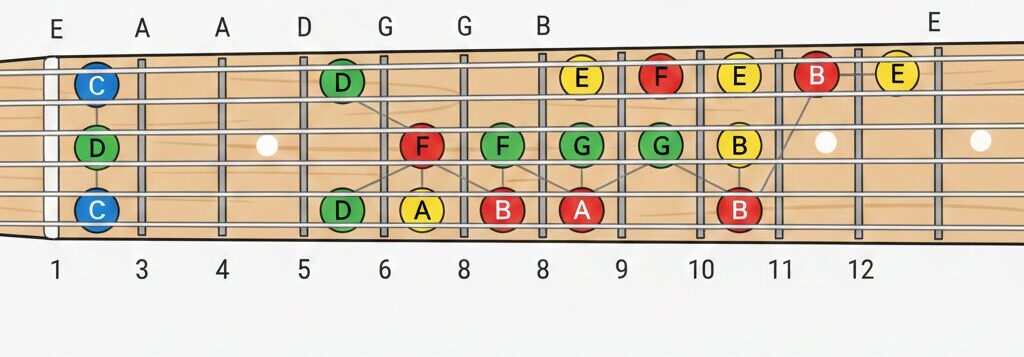
The interval formula of the major scale is:
- Whole step
- Whole step
- Half step
- Whole step
- Whole step
- Whole step
- Half step
This pattern stays the same no matter where you start on the fretboard. When you shift the pattern up or down, you are changing the key, not the structure.
The reason major guitar scales sound bright and stable is because of how these intervals are arranged. The half steps fall in places that naturally create resolution. Your ear feels like the melody knows where it is going, even if you cannot explain why.
Emotionally, major guitar scales are often described as:
- Open
- Uplifting
- Confident
- Clear
This emotional clarity is why major guitar scales are common in:
- Pop music
- Rock anthems
- Country songs
- Worship and praise music
From a practical standpoint, beginners are taught major guitar scales first because they:
- Train your ear to recognize musical resolution
- Help you understand chord progressions
- Make improvisation feel less random
When you solo using major guitar scales, your notes tend to fit naturally over many chord progressions. Mistakes are easier to hear and correct, which speeds up learning. Instead of guessing where to move next, the scale gives you a musical roadmap.
Once you truly understand the major guitar scale, learning minor guitar scales becomes much easier. The difference is not just finger placement. It is how the intervals change the emotional direction of the music.
The Minor Guitar Scale Explained Step by Step
Minor guitar scales often feel more mysterious to beginners, but the structure behind them is just as logical as major guitar scales. The difference lies in how the intervals are arranged and how your ear reacts to them.
The most important minor scale to understand first is the natural minor scale. It forms the emotional baseline for all other minor variations.

The interval formula of the natural minor scale is:
- Whole step
- Half step
- Whole step
- Whole step
- Half step
- Whole step
- Whole step
Compared to major guitar scales, the half steps appear earlier in the pattern. This small shift changes everything. The sound becomes less resolved and more emotionally charged.
Minor guitar scales are often described as:
- Darker
- Thoughtful
- Emotional
- Slightly tense
This emotional tension is why minor guitar scales are commonly used in:
- Rock music
- Blues
- Metal
- Emotional ballads and film music
Many learners think minor guitar scales are sad by default, but that is only part of the picture. Minor scales can sound aggressive, dramatic, or reflective depending on rhythm, tempo, and phrasing. The scale itself creates the mood, but how you play it tells the story.
You may also hear about other minor scale types. These are variations built from the natural minor scale.
- Harmonic minor raises one note to create stronger tension and resolution.
- Melodic minor adjusts notes differently when ascending and descending.
As a beginner, you do not need to master these immediately. What matters most is understanding how the natural minor scale feels under your fingers and in your ears.
When practicing minor guitar scales, focus on:
- Hearing the emotional pull between notes
- Connecting scale tones to chords
- Avoiding mechanical up and down playing
Once you grasp the natural minor scale, switching between major guitar scales and minor guitar scales becomes a musical choice, not a guessing game.
Major vs Minor Guitar Scales: Side-by-Side Comparison
At this point, the confusion between major guitar scales and minor guitar scales usually comes from trying to remember patterns instead of understanding function. This section clears that up by placing both side by side in a practical way.
1. Emotional Feel
- Major guitar scales
- Sound resolved and complete
- Create feelings of confidence, optimism, or calm
- Often feel like musical statements that arrive at a clear destination
- Minor guitar scales
- Sound unresolved or searching
- Create tension, depth, or emotional weight
- Often feel like a question rather than an answer
Your ear reacts to this difference instantly, even before your brain processes it.
2. Interval Structure
- Major guitar scales
- Half steps fall later in the scale
- Creates stability and balance
- Minor guitar scales
- Half steps appear earlier
- Creates emotional pull and tension
This single structural shift is why the same root note can feel happy or intense depending on scale choice.
3. Chord Compatibility
- Major guitar scales
- Fit naturally over major chord progressions
- Emphasize strong resolution tones
- Minor guitar scales
- Fit naturally over minor chord progressions
- Highlight emotional and expressive tones
Understanding this prevents random note choices when soloing.
4. Musical Context
- Major guitar scales are commonly used in:
- Pop
- Country
- Worship music
- Upbeat rock
- Minor guitar scales are commonly used in:
- Blues
- Rock and metal
- Cinematic music
- Emotional songwriting
The key takeaway is simple. Major and minor guitar scales are not competitors. They are tools. Choosing the right one depends on what the music needs to say, not what shape is easiest to play.
Read Also: What Voice Lessons Actually Teach (And What They Don’t)
How Major and Minor Scales Relate to Each Other (Relative Scales)
One of the biggest breakthroughs for guitar learners comes when they realize that major guitar scales and minor guitar scales are not separate systems. They are deeply connected through something called relative scales.
A relative major and minor scale share the exact same notes. The only difference is the note you treat as home.
For example:
- C major and A minor use the same notes
- G major and E minor use the same notes
What changes is the starting point and how your ear hears resolution. When you begin and resolve on the major root, the music sounds stable and open. When you begin and resolve on the relative minor root, the same notes suddenly feel darker and more emotional.
This matters because it:
- Cuts memorization in half
- Helps you move more freely across the fretboard
- Makes improvisation feel connected instead of boxed
On the guitar, this relationship becomes very practical. The fretboard patterns for major guitar scales and minor guitar scales overlap heavily. Many players already know both without realizing it. They just learned the same shape with a different focus note.
When improvising, relative scales allow you to:
- Shift emotional tone without changing position
- Play over chord progressions more smoothly
- Connect melodies across different sections of a song
Instead of thinking in isolated scale boxes, you start thinking in musical centers. This mindset is what separates players who memorize patterns from players who understand music.
Once you grasp relative scales, switching between major guitar scales and minor guitar scales becomes intentional. You are no longer guessing which scale to use. You are choosing how the music should feel at that moment.
How to Identify Major vs Minor by Ear (Practical Ear Training)
Being able to hear the difference between major guitar scales and minor guitar scales is more useful than naming them on paper. This skill helps you react in real musical situations, especially when playing with others or improvising.
Start with emotional recognition, not theory.
When listening to a scale or melody, ask yourself:
- Does it sound settled and open?
- Or does it feel tense, reflective, or unresolved?
Major guitar scales usually create a sense of arrival. The sound feels complete, even when played slowly. Minor guitar scales often feel inward or questioning, especially when the melody rests on the root note.
Next, focus on the third note of the scale. This is the clearest giveaway.
- A major third sounds wide and uplifting
- A minor third sounds closer and more serious
You can train this by playing just three notes on your guitar:
- Root
- Third
- Root again
Do this slowly. Let your ear absorb the difference instead of rushing to the next exercise.
Here are simple daily ear training drills:
- Hum the root note, then play the third and notice how it feels
- Play a short melody and stop on the third to hear its emotional pull
- Listen to familiar songs and identify whether the melody leans major or minor
Common mistakes beginners make include:
- Listening too fast without letting notes settle
- Trying to analyze before feeling the sound
- Relying only on scale shapes instead of sound
Correct this by slowing down and singing notes before playing them. When your ear improves, choosing between major guitar scales and minor guitar scales becomes instinctive, not forced.
How Guitarists Actually Use Major and Minor Scales
Understanding guitar scales matters most when you see how they function in real playing situations. Professional and experienced guitarists do not think in isolated scale shapes. They think in sound, context, and intention. Major and minor scales are tools they choose based on what the music needs.
When improvising over chord progressions, guitarists listen to the emotional center of the progression.
- Progressions built around major chords usually pair naturally with major guitar scales.
- Progressions centered on minor chords lean toward minor guitar scales.
This does not mean the scale runs nonstop. Guitarists often select a few strong notes from the scale and build phrases around them.
When soloing, players often switch between major and minor sounds for contrast. For example:
- Starting a solo with a major guitar scale can establish brightness.
- Sliding into a minor guitar scale adds tension or depth.
This contrast keeps solos expressive instead of repetitive.
In songwriting, guitar scales act like emotional maps.
- A riff built from a minor guitar scale often feels heavier or more reflective.
- A chorus written from a major guitar scale usually feels open and memorable.
During jamming sessions, guitarists rely on their ears more than rules. They listen to the bass and rhythm guitar to determine whether the groove feels major or minor, then adjust their scale choice accordingly. This is why ear training matters as much as memorization.
Real-world examples include:
- Playing over a backing track and identifying its emotional tone before choosing a scale
- Writing a melody that follows chord movement instead of running a scale pattern
- Simplifying solos by focusing on strong scale tones rather than speed
When you stop treating guitar scales as drills and start using them as expressive tools, major and minor scales become part of your musical voice, not just fretboard knowledge.
Read Also: Learning Drums for Beginners: What You Need to Know First
Common Beginner Mistakes With Guitar Scales (And How to Fix Them)
Many beginners struggle with guitar scales not because the material is hard, but because of how it is practiced. Recognizing these mistakes early saves months of frustration and makes major and minor guitar scales feel useful instead of mechanical.
1. Playing scales mechanically
- Why it happens: Learners focus on finger order instead of sound.
- How to fix it:
- Pause on important notes instead of rushing through patterns
- Sing the notes while playing to connect ear and fingers
- Practice short phrases rather than full scale runs
2. Ignoring rhythm
- Why it happens: Scales are practiced without timing.
- How to fix it:
- Use a metronome and vary note lengths
- Play the same scale using quarter notes, eighth notes, and rests
- Tap your foot to internalize pulse
3. Staying stuck in one position
- Why it happens: One pattern feels safe.
- How to fix it:
- Learn how major guitar scales connect across positions
- Shift up or down the neck during simple runs
- Practice moving between two adjacent positions smoothly
4. Not connecting scales to chords
- Why it happens: Scales are learned separately from songs.
- How to fix it:
- Identify chord tones inside minor guitar scales and major guitar scales
- Target those notes when improvising
- Practice scales over real chord progressions
5. Playing too fast, too soon
- Why it happens: Speed feels like progress.
- How to fix it:
- Slow practice builds accuracy and confidence
- Increase tempo only when notes sound controlled and clean
Fixing these habits transforms guitar scales from exercises into musical tools that actually support improvisation and songwriting.
How to Practice Major and Minor Guitar Scales the Smart Way
Practicing guitar scales effectively is less about time spent and more about structure. Beginners often repeat major guitar scales and minor guitar scales without a plan, which leads to slow progress. A smarter approach builds control, understanding, and confidence at the same time.
1. Use a clear practice structure
- Start with one scale per session to avoid overload
- Decide whether you are focusing on tone, timing, or fretboard movement
- Keep sessions short but focused, even 20 minutes works
2. Practice with time, not speed
- Set a metronome at a slow, comfortable tempo
- Play each note evenly and cleanly
- Increase tempo only after maintaining control for several repetitions
- This builds reliable timing, not rushed playing
3. Break scales into musical pieces
- Practice scales in short phrases of three to five notes
- Pause between phrases to reset your hands
- This helps guitar scales feel like music instead of drills
4. Map the fretboard intentionally
- Practice major guitar scales in two adjacent positions
- Connect them by sliding or shifting instead of jumping
- Apply the same approach to minor guitar scales so patterns overlap naturally
5. Change how you play the same scale
- Use different rhythms such as long and short notes
- Add simple bends or slides where appropriate
- Ascend slowly and descend with variation
6. End with application
- Play over a backing track in the same key
- Improvise using only a few notes from the scale
- Focus on sound choices, not note quantity
This approach turns guitar scales into tools for expression rather than finger workouts, making progress easier to hear and feel.
Conclusion
Understanding the difference between major and minor guitar scales is more than a theory lesson, it’s a gateway to playing with expression, confidence, and creativity. While memorizing patterns can help, true progress comes from grasping how scales affect mood, chord compatibility, and improvisation choices. Major scales bring brightness and resolution, while minor scales add tension, emotion, and depth. Together, they give you the tools to craft solos, riffs, and melodies that feel intentional and musical.
At Educify, we offer beginner-friendly lessons that focus on understanding music, not just rote patterns. You’ll learn practical applications of major and minor guitar scales, exercises tailored to your level, and strategies to improvise confidently.
Start your journey with us today and turn scale practice into real musical expression 🎸.














5 Responses