

Introduction
You’ve probably heard the name “JavaScript” thrown around in conversations about web development, coding bootcamps, or tech careers. But what exactly are the uses of JavaScript, and why does it seem like everyone is talking about it? If you’re a student exploring programming options or a parent researching the best skills for your child’s future, you’ve come to the right place.
In this comprehensive guide, we’ll break down everything you need to know about JavaScript, from what it does to why it’s one of the most valuable programming languages to learn in 2026. Whether you’re completely new to coding or looking to expand your tech skills, we’ll walk you through JavaScript’s real-world applications, advantages, and what you can expect when you start learning this powerful language.
Understanding JavaScript: The Language That Powers the Internet
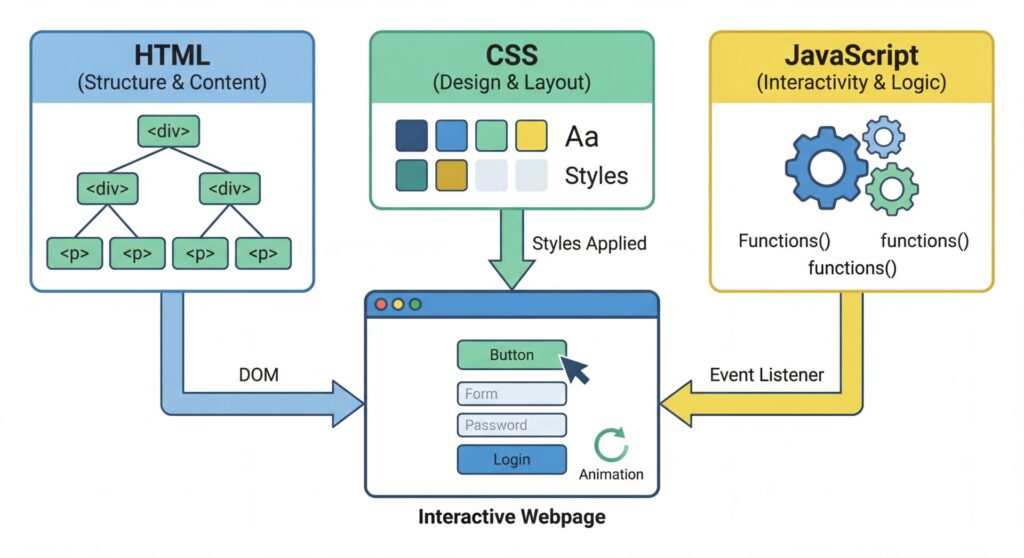
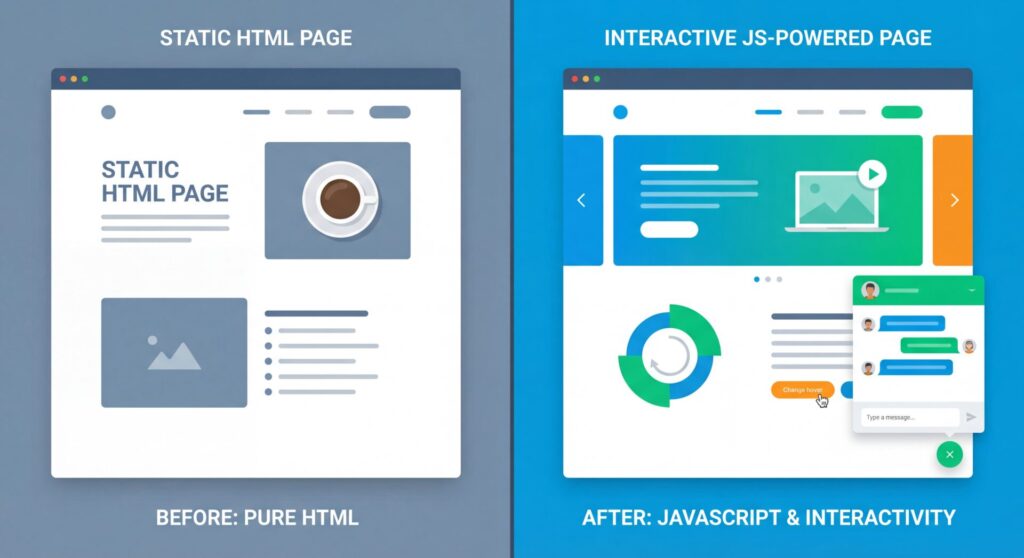
Let’s start with the basics: what is JavaScript used for? JavaScript is a versatile programming language that brings websites to life. While HTML provides the structure of a webpage (like the skeleton of a building) and CSS adds the styling (like paint and decoration), JavaScript is what makes everything move, respond, and interact with you.
Think of it this way: if a website were a car, HTML would be the frame and body, CSS would be the paint job and interior design, and JavaScript would be the engine, transmission, and all the systems that make the car actually drive. Pretty cool, right?
Created in 1995 by Brendan Eich, JavaScript has evolved from a simple scripting tool into one of the most powerful and widely-used programming languages in the world. According to recent developer surveys, JavaScript maintains an impressive 66% adoption rate among software developers globally in 2026, making it the most commonly used programming language for web development.
The uses of JavaScript span across virtually every corner of the internet. When you click a button and see a menu slide down, that’s JavaScript. When you type into a search box and see suggestions appear instantly, that’s JavaScript at work. When you watch a video player adjust to your screen size or see animations smoothly transition across a page, you’re witnessing the power of JavaScript in action.
What makes JavaScript particularly special is that it runs directly in your web browser. This means you don’t need to install complicated software or set up special environments to start learning, you can begin writing JavaScript code right now using just your computer’s web browser. This accessibility is one reason why JavaScript has become the go-to language for beginners and professionals alike.
JavaScript is also what developers call a “high-level” programming language, which means it’s designed to be relatively easy for humans to read and write. Unlike some programming languages that require you to manage complex technical details, JavaScript handles much of the heavy lifting behind the scenes, letting you focus on creating amazing things.
The Amazing Uses of JavaScript in Web Development
Now that you understand what JavaScript is, let’s dive into the uses of JavaScript in web development, because this is where things get really exciting. JavaScript is the backbone of modern web development, and its applications are practically limitless.
1. Making Websites Interactive and Dynamic
The primary use of JavaScript is creating interactive web experiences. Every time you interact with a website in a meaningful way, JavaScript is probably involved. Here are some everyday examples you’ve definitely encountered:
- Form Validation: When you fill out a registration form and immediately see a message telling you your password is too short or your email format is incorrect, that’s JavaScript checking your input in real-time. This instant feedback makes websites more user-friendly and helps catch errors before you submit information.
- Interactive Maps: Services like Google Maps use JavaScript extensively. When you zoom in, drag the map around, or click on a location for more information, JavaScript is processing your actions and updating what you see instantly.
- Image Sliders and Carousels: Those photo galleries that automatically rotate through images or let you click arrows to browse? That’s JavaScript controlling the timing, transitions, and user interactions.
- Drop-Down Menus: Navigation menus that expand when you hover over them or click a hamburger icon rely on JavaScript to show and hide content smoothly.
- Real-Time Updates: Social media feeds that update without refreshing the page, live sports scores, stock tickers, and chat applications all use JavaScript to fetch new data and display it instantly.
2. Building Single-Page Applications (SPAs)
One of the most important uses of JavaScript in web development is creating Single-Page Applications. Unlike traditional websites that reload entirely when you click a link, SPAs load once and then dynamically update content as you navigate. This creates a smoother, faster experience that feels more like using a mobile app than browsing a website.
Popular platforms like Gmail, Facebook, Twitter, and Netflix all use this approach. When you click through your email inbox or scroll through your social media feed, you’re experiencing the power of JavaScript-driven SPAs. These applications feel incredibly responsive because JavaScript is updating just the parts of the page that need to change, rather than reloading everything from scratch.
3. Creating Web Applications
JavaScript in web development has evolved far beyond simple website enhancements. Today, entire complex applications run on JavaScript. Online tools like Google Docs, Trello, Figma, and Notion are sophisticated web applications built primarily with JavaScript. These aren’t just simple websites, they’re powerful software programs that run entirely in your browser.
This shift has been revolutionary. Instead of downloading and installing software on your computer, you can access these applications from any device with a web browser. Students can work on a project at school, continue at the library, and finish at home—all without installing anything. That’s the flexibility JavaScript enables.
4. Enhancing User Experience with Animations and Visual Effects
JavaScript allows developers to create stunning visual effects that make websites more engaging and enjoyable to use. Smooth scrolling effects, animated charts and graphs, interactive infographics, parallax effects (where background images move at different speeds than foreground content), and loading animations all enhance the user experience and make websites feel modern and polished.
These aren’t just decorative, they serve important purposes. Animations can guide users’ attention to important information, provide feedback that an action was successful, and make waiting for content to load less frustrating. The advantages of JavaScript include the ability to create these experiences without requiring users to download plugins or additional software.
JavaScript Beyond the Browser: Mobile Apps, Games, and More
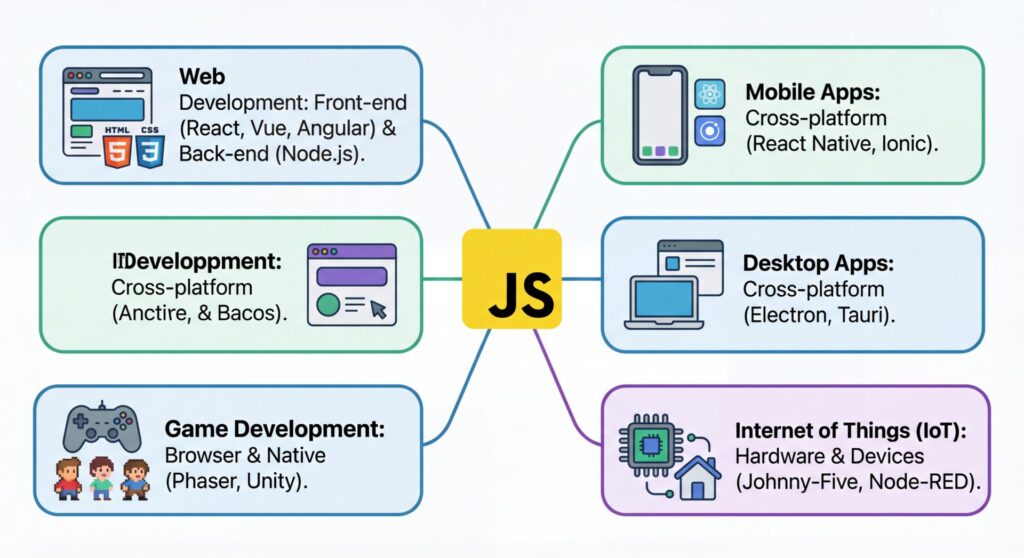
While web development is JavaScript’s primary domain, the uses of JavaScript extend far beyond traditional websites. Let’s explore some exciting applications you might not expect.
1. Mobile App Development
One of the most valuable uses of JavaScript today is building mobile applications for both iOS and Android devices. Frameworks like React Native and Ionic allow developers to write code once in JavaScript and deploy it to both Apple and Android app stores. This is a game-changer for businesses and developers because it means you don’t need to learn completely different languages for each platform.
Popular apps like Instagram, Facebook, Airbnb, Tesla, and Discord all use JavaScript-based frameworks for their mobile applications. When you’re scrolling through your Instagram feed or booking an Airbnb on your phone, you’re using an app powered at least partially by JavaScript.
For students interested in app development, learning JavaScript opens doors to both web and mobile development—two careers for the price of one learning investment!
2. Server-Side Development with Node.js
Here’s something that surprises many people: JavaScript isn’t just for the front-end (what users see) anymore. With a technology called Node.js, JavaScript can also power the back-end (the server-side logic and database operations). This means you can use JavaScript to build the entire stack of a web application, from the user interface to the server and database.
Companies like Netflix, LinkedIn, Uber, PayPal, and NASA use Node.js for their server infrastructure. The advantages of JavaScript in this context include the ability to use one language across your entire application, making it easier for developers to work on different parts of a project and share code between front-end and back-end.
3. Game Development
JavaScript has become a legitimate option for game development, especially for browser-based and casual games. While it might not be the first choice for creating the next AAA console game, JavaScript is perfect for creating engaging web games, educational games, and mobile games.
Popular browser games, interactive learning games for education, puzzle games, and even some 2D and simple 3D games can all be built with JavaScript. Frameworks like Phaser, Three.js, and Babylon.js provide powerful tools for game developers working with JavaScript.
For students interested in game development, starting with JavaScript offers a gentle introduction to programming concepts while still allowing you to create fun, playable games relatively quickly.
4. Desktop Applications
Believe it or not, JavaScript can even be used to create desktop applications that run on Windows, Mac, and Linux computers. Technologies like Electron allow developers to build cross-platform desktop apps using JavaScript, HTML, and CSS.
Some applications you might use regularly that are built with JavaScript include Visual Studio Code (a popular code editor), Slack (the communication platform), Discord (the chat and voice platform), and Spotify’s desktop app. These are full-featured desktop applications, not just websites in a window.
5. Internet of Things (IoT) and Smart Devices
JavaScript is even making its way into the Internet of Things. Smart home devices, wearable technology, and embedded systems can all be programmed with JavaScript. While this is a more advanced application, it demonstrates just how versatile JavaScript has become.
The Advantages of JavaScript: Why It’s Perfect for Beginners
If you’re considering learning your first programming language, JavaScript offers numerous advantages that make it an excellent choice. Let’s explore why JavaScript stands out as the ideal starting point for aspiring developers.
1. Easy to Get Started
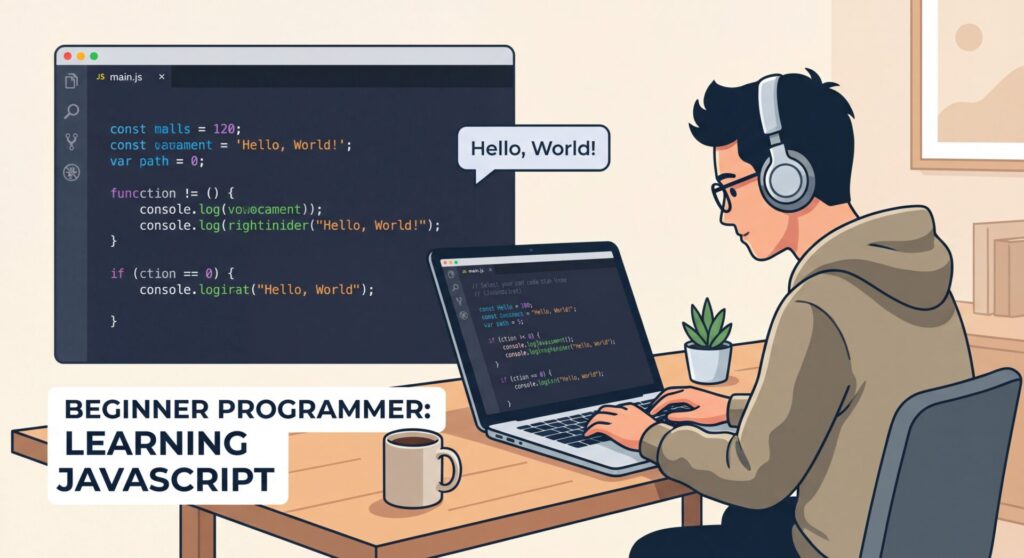
One of the biggest advantages of JavaScript is its incredibly low barrier to entry. Unlike many programming languages that require you to download compilers, set up development environments, or configure complex tools, JavaScript runs directly in every web browser. This means you can start writing and testing JavaScript code within minutes using just a text editor and the browser you already have on your computer.
For students and beginners, this accessibility is invaluable. You don’t need permission to install software on your school computer, you don’t need a powerful machine, and you don’t need to spend hours setting up your environment before writing your first line of code. Open a browser, open the developer console (usually by pressing F12), and you’re ready to go.
2. Beginner-Friendly Syntax
JavaScript’s syntax, the way you write code, is relatively intuitive and reads almost like English in many cases. Commands like alert(), console.log(), and getElementById() tell you pretty clearly what they do. This natural language feel makes JavaScript less intimidating for beginners compared to languages with more cryptic syntax.
Additionally, JavaScript is a “forgiving” language in many ways. It won’t crash your entire program over small mistakes the way some stricter languages might. This gives beginners room to experiment, make mistakes, and learn from them without getting discouraged.
3. Instant Visual Feedback
When you’re learning to code, seeing immediate results from your work is incredibly motivating, and that is the third advantage of learning javascript. JavaScript excels at providing instant visual feedback. Write a few lines of code to change text on a webpage, and you’ll see the change immediately. Create a button that changes colors when clicked, and you can test it right away.
This immediate gratification keeps learners engaged and makes it easier to understand cause and effect in programming. You’re not writing abstract code that does mysterious things behind the scenes, you’re creating visible, interactive elements you can play with and show to friends and family.
4. Massive Community and Resources
JavaScript has one of the largest and most active developer communities in the world. This means there are countless tutorials, courses, forums, documentation sites, YouTube channels, and coding communities dedicated to helping people learn js. Whenever you get stuck or have a question, you can find answers quickly through resources like Stack Overflow, MDN Web Docs, freeCodeCamp, and countless other platforms.
For students at Educify, this extensive community support complements our structured curriculum, giving you multiple ways to learn and explore concepts that interest you.
5. Versatility and Career Opportunities
Learning js isn’t just about building websites, it’s about opening doors to numerous career paths. Another advantage of JavaScript is its versatility which means that once you learn it, you can work as a front-end developer, back-end developer (with Node.js), full-stack developer, mobile app developer, game developer, or even explore emerging fields like IoT development.
According to 2026 job market data, JavaScript developers are among the most in-demand tech professionals, with an average salary of $102,705 in the United States. Junior JavaScript developers can expect starting salaries around $80,000, while experienced developers can earn well over $150,000 annually. The job market for JavaScript developers is projected to grow 16% from 2025 to 2035—much faster than the average for all occupations.
6. Transferable Skills
Another significant advantage of learning JavaScript is that the concepts you master will transfer to other programming languages. JavaScript teaches you fundamental programming concepts like variables, functions, loops, conditionals, and object-oriented programming. Once you understand these concepts in JavaScript, learning languages like Python, Java, C++, or Ruby becomes much easier.
JavaScript supports multiple programming paradigms (ways of organizing and writing code), including object-oriented, functional, and imperative programming. This exposure to different approaches makes you a more well-rounded programmer and prepares you for whatever language you might need to learn in the future.
7. Active Development and Modern Features
JavaScript is constantly evolving with new features and improvements. The language is standardized through ECMAScript, which releases new versions regularly. This means JavaScript stays modern and continues to incorporate best practices and features that make development easier and more efficient.
For learners, this means you’re investing time in a language that’s actively maintained and improved, not one that’s stagnating or being replaced. The JavaScript you learn today will remain relevant for years to come.
16% growth from 2025 to 2035 – JavaScript Developer Demand
66% of developers worldwide – JavaScript Adoption Rate
Check out related articles on web development:
Conclusion
JavaScript has earned its reputation as one of the most important and versatile programming languages in the world. From powering interactive websites to enabling mobile app development, from creating engaging games to building server-side applications, the uses of JavaScript span virtually every corner of modern technology. For students and aspiring developers, learning js offers an accessible entry point into programming with a gentle learning curve, instant visual feedback, and a massive supportive community.
The advantages of JavaScript, including its versatility, strong job market demand, and transferable skills, make it an excellent investment of your learning time. Whether you’re a student exploring potential career paths or a parent researching educational opportunities for your child, JavaScript represents a skill that opens doors to numerous exciting possibilities in our increasingly digital world.
Ready to start your JavaScript journey? Learn with expert tutors at Educify today!
One Response